


Do you want to grow many tomatoes in small spaces, including containers? Have you ever thought about how commercial hydroponic growers maximize plant density in their growing areas? By understanding how tomatoes grow, we can choose the right plants and use their growth habits to produce the most fruit in the smallest areas.
Determinate Versus Indeterminate Tomatoes
Tomato varieties are classified into two categories based on their growth habit: determinate and indeterminate.
Determinate tomato varieties are known as ‘bush tomatoes’; they grow into self-supporting small bushes up to 1.2m (4′) tall that don’t need staking. They grow to full size, then produce flowers at the ends of all their branches (shoots), producing the entiretomato crop at once.
Indeterminate tomato varieties are known as ‘vining tomatoes’; they grow very long stems around 2m (6′) tall, which branch heavily and require staking or tying to a support to keep them off the ground. Flowers are produced along the sides of the branches (shoots), and the plants will continue to grow until the cold weather arrives.
Pruning Indeterminate Tomatoes Into a Columnar Shape
Since indeterminate tomatoes flower alongside any new shoots that emerge, and continue growing after flowering, their continuous productivity makes them ideal plants for intensive growing systems.
A plant’s available growing energy can either go into vegetative growth (leafy green growth, basically leaves and branches) or flowering and fruiting productive growth. We can direct the plant’s growth into flowering and fruiting by preventing new shoots (branches) from forming through pruning.
Unlike determinate bush tomatoes, which fruit at the ends of their branches and therefore need branches to fruit, indeterminate tomatoes don’t. A stem and leaves will do the job.

As the picture below shows, cutting off new shoots (branches) growing from the stem does not affect the flowers, because the flowers form on the stem.

If we prune off all new shoots (branches), we end up with a tall plant that is composed of a stem with leaves along its length and flowers emerging from it — essentially a columnar tomato plant — tall and narrow — the ideal shape for intensive plantings where many plants are fit into a small space!

Bonus: turn prunings into new plants. Don’t throw away any pruned shoots; you can easily turn them into new tomato plants! Just put them in a bucket with some water in the bottom, and place them in a protected area exposed to morning sun only.

In a few days, the cuttings will root!

Hydroponic-Style Supports for High-Density Plantings
When you prune tomato plants to be tall and narrow, you can space them quite closely, even in containers.
Pictured below are three tomatoes planted side by side in two self-watering containers, supported by strings attached to an overhead frame. The pots are 70cm (28”) wide, with the tomatoes spaced around 25cm (10”) apart, quite an effective use of space!

How String Supports Work
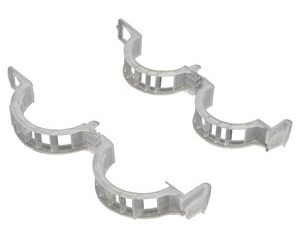
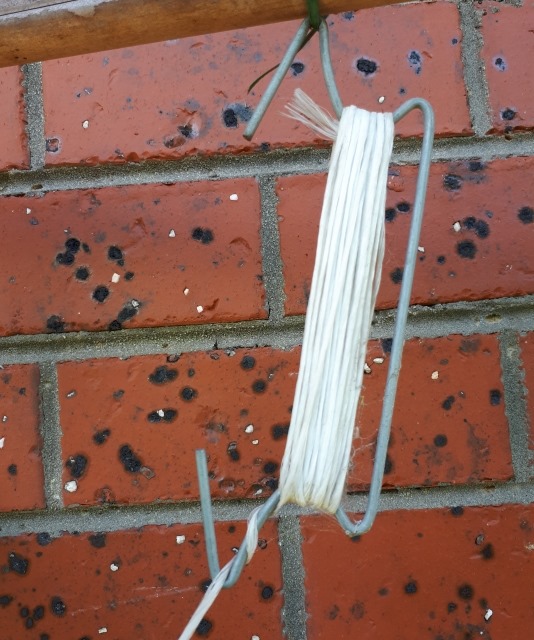

To support tomatoes on strings, as in hydroponic setups, attach hydroponic tomato clips (as pictured below) to the base of each tomato plant, then tie the string to an overhead support and wind the tomato stem around the taut string.
Here is a tomato stem supported on a string; the stem is just wound around the string as it grows, and any new shoots (side branches) are pruned off. This maintains the narrow shape as the tomato grows upwards only.
Building Your Own Support Frame

With this setup, you can grow tomato plants very close together, and it’s cheaper than using wooden stakes. The plastic string lasts several years and is extremely cheap to replace.
Spacing and Disease Prevention
I built my support frame from square aluminium sections that connect with plastic fittings that simply push together, all purchased from a local hardware store. Since these materials don’t rust or crack, they can withstand the weather and last almost indefinitely.
There is no limit to what you can use as overhead support to hang the strings from. Two wooden tomato stakes in the ground with at third lashed to the top to form an inverted ‘U’-shape will work perfectly well in a garden bed.
For spacing, I’ve used a distance of 45cm (18″) between plants in the ground in garden beds, and in my experience this provides plenty of air circulation to prevent diseases. When planting in the ground, I always remove all leaves off the bottom 30cm (12″) of the tomato plant once it’s tall enough, as this prevents soil splash from the rain reaching the leaves, which causes that all too familiar disease where the bottom leaves dry out, and the infection slowly spreads upwards. A thick layer of mulch also helps prevent.. this problem.
By borrowing a few tricks from hydroponic growers, you can achieve high-density, high-productivity tomato plantings in even the smallest of spaces. Give it a try — your garden bed will thank you.