

Fruit trees naturally reproduce from seeds, but most fruit trees you buy are not grown that way for very good reasons. There are many ways to propagate fruit trees, and each method has its advantages and disadvantages.
Whether you propagate fruit trees yourself or buy them from a garden nursery, all fruit trees are produced by the following methods – they may be grafted, grown from rooted cuttings, produced by air layering (also referred to as aerial layering or marcotting), or they may be seedlings grown from seed.
Why Not Just Grow Fruit Trees from Seed?
The difference between growing plants from seed and propagating plants from cuttings of a parent plant is genetic variation.
The seeds of many fruit trees produce offspring that are different from the parent, because seeds are produced by sexual reproduction – they receive genes from both a male and a female parent. As they are a cross between two sets of genes, many fruit trees are not “true to seed”, that is, their seeds will produce a different variety of tree from the parent. For the botany purists, yes, there are some exceptions, but this is generally the case.
Propagation methods that use material from the parent trees, such as cuttings, are a form of vegetative or asexual reproduction, as genes come from only one parent, producing genetically identical clones.
Let’s have a look at a real-life example to better understand this concept. Imagine we want to produce more Granny Smith apple trees from an existing tree. Apples are not ‘true to seed’, so the seeds from any particular variety will not grow into trees that are the same variety as the tree they came from. In our case, Granny Smith apple seeds will produce a wide variety of different and unknown apple tree types.
So what might you say? Well, consider that not all varieties of apple produced will taste good. Some may not be palatable or even edible at all! If you’re wanting to produce Granny Smith apples, you’ll have the problem that none of the apple tree seedlings will be Granny Smith apples, but something else instead. You won’t know how productive the tree will be, what shape or size it will grow to, what part of the season it will fruit, how big the fruit will be, or how the fruit will look or taste. There is a rare chance that the fruit will be as good as or better than the parent tree, but the odds are stacked against you!
Why do plants mix and match their genetic material and constantly change? Basically, to create genetic diversity and variation, as a mechanism to adapt to different conditions and enhance their chances of survival and reproduction. If every seed produces a tree with different attributes, there’s a much higher probability that one or more trees will survive to grow into mature trees and continue to produce the next generation in the event of a detrimental environmental change.
So, if many fruit trees are not “true to seed” and intentionally produce genetic diversity in their seedlings as a survival strategy, what can we do if we want to preserve the parent plant’s qualities, including the size, quality and flavour of the fruit, as well as many other desirable characteristics? The solution is simple. We can use propagation methods that produce genetic clones of the parent tree, which we’ll now discuss.
Why Are Most Fruit Trees Grafted?
Many fruit trees are grafted because they do not grow true to seed. Only by grafting the scion wood (a cutting of a branch) from the original tree onto another rootstock (the base of another tree with roots) can you ensure that you get the same fruit each time.
If we consider Granny Smith apples, for example, the scion wood of all grafted trees of this variety, all around the world, can be traced back to a single tree in one part of the world! Quite amazing when you think about it. In the case of the Granny Smith apple variety, it all originated from a single seedling that came up by chance from a pile of discarded crab apples in Australia in 1868 and was discovered by Maria Ann Smith, who propagated the cultivar. In each part of the world where a Granny Smith apple is grown, scion wood, which is a clone of the parent tree, will be grafted onto various different rootstocks to cope with the local growing conditions.
There are many grafting techniques used in different circumstances and on different trees. The diagram below illustrates how basic cleft grafting (also known as V-grafting) works.

Because scion wood is a cutting with the same genetic maturity as the parent plant, a grafted tree fruits much sooner. So, if a plant takes six years to produce fruit when grown from seed, a grafted tree may only take two to three years to produce fruit. This saves a lot of waiting around and avoids having unproductive trees taking up space in a garden for many years.
For example, an avocado grown from seed may take 6 to 10 years or longer to fruit, whereas a grafted tree will produce fruit in 3 to 4 years.
Grafting allows different rootstocks to be attached to trees, enabling them to grow in soils where they normally can’t. If you plant a tree in a location where it wouldn’t grow naturally, it will have a shorter life. If you graft a tree using an appropriate rootstock, it will be better able to handle adverse conditions. Specific rootstocks can be used to cope with different soil types and conditions, such as heavy or clay soils, or to resist particular diseases. The general rule with rootstock is that like is grafted onto like, apples onto apple rootstock, pears onto pear rootstock, and so on.
Grafting can be used to control the size of the tree. It’s used to produce everything from fully dwarfed trees to full-size trees and everything in between. Semi-dwarf and dwarf trees are produced by grafting onto a less vigorous rootstock. In the worst cases, such as with fully dwarfing apple rootstocks like the M9, the root system is so weak that it can’t hold the apple tree up, and it has to be staked for life. Fortunately, these rootstocks aren’t what’s used when you buy a dwarf apple tree from a retail garden nursery, so there’s no need to be concerned.
Citrus is always grafted onto specific rootstocks such as flying dragon to create dwarf citrus trees, or trifoliata to grow full-size trees suited to specific soils. Trifoliata rootstock performs well in heavier clay loams and loamy soils in cooler climates, and is resistant to citrus nematode and some species of phytophthora (a soil-borne water mould that causes root rot).
It’s important to realise that grafted trees don’t live as long as seed-grown trees, but both types have naturally formed roots, which provide some advantages over cutting-grown trees.
Which Fruit Trees Can Be Grown from Cuttings?
Some fruit trees grow well from rooted cuttings and will fruit as soon as they have enough roots to support fruit production. Mediterranean fruit trees such as figs, pomegranates and mulberries, as well as climbers such as grapes and kiwifruit, can all be grown from hardwood cuttings to produce genetic clones, with no need for seedling-grown trees or grafting. When you buy these trees, they are most often grown from cuttings.

Cuttings-grown plants typically have a weaker root system than seedlings or grafted trees, but to keep things in perspective, grafted dwarf trees are intentionally grafted onto weaker root systems, which is what makes them dwarf trees.
If the tree type has a deep taproot (and not many fruit trees do), this will only be present in a seedling root (and on a grafted rootstock). Tree cuttings don’t develop taproots, as this structure forms at the seedling stage.
Air Layering Trees (Marcotting)
Some trees are propagated by inducing branches to form roots while they’re still attached to the tree, then cutting them off after they have sprouted roots!
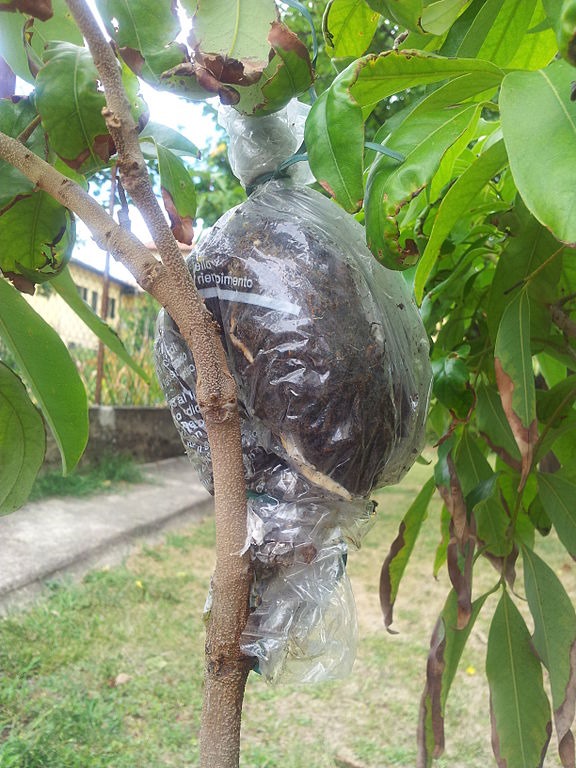
Lychee air layer on a small potted plant (Photo source: Iacopo Lorenzini (Own work) via Wikimedia Commons)
Cuttings produced by aerial layering (also known as air layering or marcotting) grow and behave exactly the same way as cuttings rooted conventionally.
With air layering, a ring of bark is removed from the branch, but the branch is left on the tree. The exposed wood is covered with a moisture-retaining medium such as moist sphagnum moss or coco-peat (coconut coir) and wrapped in plastic to retain moisture until roots form. Once the roots are sufficiently developed, the branch is cut and potted to continue growing and to develop a stronger root system.
Air layering is used when propagation by regular cuttings doesn’t work well, and is often used on evergreen trees, including many subtropical and tropical trees. This method also works on citrus, which is an evergreen tree, but citrus are better propagated using bud grafting or shield grafting, which are different from the cleft or V graft mentioned earlier.
Seedling Grown Trees
As we’ve already mentioned, there are certain advantages and disadvantages to seedling-grown trees.
If a fruit tree is not true to seed, the seedlings will differ from the parent and often take many years longer to fruit, in some cases well over ten years. That can be disappointing if you wait that long only to find the fruit tastes nothing like the parent tree’s fruit!
One major use for seedling trees is as grafting rootstock, as they have a strong root system that makes them ideal for grafting known varieties onto.
Seedling-grown trees live longer than grafted trees or cutting-grown trees. They’re more vigorous and grow slightly larger. They’re also much stronger and hardier, and more likely to survive frosts. If a grafted tree is hit hard by frost, the graft usually dies, but the rootstock survives. With a seedling-grown tree, if the rootstock survives a hard frost, it will usually reshoot from the ground.
Apples and pears are never true to seed, but tamarillos can be grown from seed.
Apricots, peaches and nectarines grow fairly true to seed. Some say plums do too. They won’t be exact, but often quite close. A good, cheap option, though, if you’re guerrilla gardening around the suburbs in vacant public spaces!
Gardeners often ask whether they can grow citrus or avocado from seed. The answer is both yes and no, as these require a bit of an explanation…
Can Citrus Trees be Grown from Seed?
Most citrus are true to seed because they are polyembryonic. The seeds contain more than one plant embryo. Only one embryo is the product of fertilisation (sexual reproduction), and the rest are genetic clones of the parent tree. When these seeds are grown, they produce multiple shoots. The fertilised one is usually the weakest and is removed.
The following citrus are monoembryonic and do not grow true to seed – Clementine Mandarin, Meyer Lemon, Nagami Kumquat, Marumi Kumquat, Pummelo, Temple Tangor, and Trifoliate Orange (also known as Citrus trifoliata, Poncirus trifoliata, Japanese bitter-orange, or Chinese bitter orange).
Can Avocado Trees be Grown from Seed?
Avocado seeds may be polyembryonic, but they might not be; it depends on the variety. It can be confusing to identify which is which, because monoembryonic seedlings (which are not like the parent tree) can produce multiple shoots that can be mistaken for multiple embryos. However, they won’t be genetic clones of the parent tree; they are a completely different tree.
Mangoes such as the Bowen (Kensington Pride) variety are polyembryonic and will grow true to seed, so this may be a better choice.
Conclusion
Hopefully, with this understanding of the differences between seedling, grafted and cutting-grown fruit trees, you won’t be waiting years to discover that your seed-grown fruit tastes awful. You’ll know what to grow from seed or cutting, and you might even feel enticed to give air layering or grafting a go!
good information. thank you!
Thank you for that, very informative and will save me from disappointment with the Cox’s I have just grown from seed.
thank you so much… was so helpful 🙂
wonderful piece of research.thumbs up to you!
O.O thanks
Hi,
I’m growing Kiwi from seeds, but it grows very slow.
Is it possible to grow kiwi from seeds ? :/
Kiwifruit will grow from seed, but there are two major problems with this approach.
1. Kiwifruit is not ‘true to seed’ or true to type, the seeds will produce different plants from the parent, taste, size, etc of fruit will be different.
2. Kiwifruit are dioecious, meaning that you need both male and female plants for pollination, and you won’t know the sex of the plants till they flower, which means you have to grow them for approximately three years, and they get very big by then.
This is why kiwifruit is either grafted or cutting grown.
Thank you.
Do you think which kind of fertilizer that kiwi baby-plants need now, to grow more faster ?
Any well-balanced general purpose fertilizer will be adequate for providing the necessary nutrients to young kiwifruit.
I found this article very informative and helpful enough. And I’ll be using it as a reference. May I know who the author of this article is?
Thanks for the great feedback! I’m the author of this website, you can read more about me here – https://deepgreenpermaculture.com/home/about/
Of all the articles about tree propagation I have read I found this the best. Brief but comprehensive.
Thank you for this article.
It Is the best written
article I have read sofar on google.
it has clarified many concepts I had no idea of, while clarifing many othe I could not fully understand when, as a child, I used to watch my fater work aroun in our very small farm.
very helpful article. Thank you.
Very helpful, thanks much!
I would like to use your grafting image for a local school workbook. How can I get in touch with you?
Hi, my contact details are on the About the Author page, you’ll find my email address there, please send me an email, thanks.
Excellent information. Thank you.
I thank you very much for this most informative and clearly written article.
I have a grafted finger lime that I would like to move to another location .
Would it be safe to transplant it.
Treat it like any other citrus or evergreen tree when relocating, move it in early spring to allow root regrowth, which can only happen when the tree is growing. Dig out as much of the rootball as possible with the least disturbance to it, Water with seaweed extract to stimulate root growth. I successfully transplanted my fingerlime tree two years ago and it’s now fruiting well.
Hello Team, I am Peter Heri from Tanzania. Sorry can scion taken from second or third generation have different fruit quality from the scion taken from first generation?
Hi Peter, thanks for your question, great to hear from our readers all the way from Tanzania!
All grafted fruit trees are genetic clones of the original parent tree, and should have exactly the same fruit as the parent tree, the only thing that will be different will be the size of the tree, which is driven by the rootstock the scion is grafted onto.
With any grafted fruit tree, the scion wood is taken from the original parent tree, and grown on the roots of other similar trees to provide more of the original parent tree scion wood, which can be used to graft more trees. In effect, all fruit trees of a specific variety are just propagated from cutting of the original tree, and cuttings of those cutting, for many generations, but instead of putting the cuttings into the soil to grow their own roots, the cuttings are just attached to the roots of existing trees.
Thanks for the information! How high will the plant be if I grow from grafting vs. from seed? Will the grafting plant be smaller than the one from seed? Thanks!
A seed grown tree will always be much taller and larger than a grafted one. How high will it be? It depends on the type of tree. A seed grown loquat for example will grow up to 10m (30′) tall, that’s a very big tree! A grafted ones will probably be half that size.
Great information here! Thank you very much. I am blessed to have six amazing mature Meyer Lemon trees. Can I plant their seeds and use them as rootstock? And then graft an air-layered cutting onto that rootstock from those same trees? Or is there a better method you’d recommend? Mahalo from Maui! 🙂
Thanks, you’re welcome!
Yes, you can use the Meyer lemon seedlings as rootstock as long as they are able to survive in the type of soil in your area. One of the reasons why specialised citrus rootstock are used is to cope with difficult soil conditions, such as heavy clay soils for example.
The traditional method of propagating citrus trees is to use a bud graft to graft the original Meyer lemon scion wood onto whatever citrus rootstock you are choosing to use.
Air layering (marcotting) is used to propagate trees by causing the branches to root, creating a rooted cutting, there is no grafting involved. This will only work if Meyer lemons can grow on their own roots in your soil type.
Hope this helps! 🙂
Thank you so much for this article. It is informative, well written and I can see myself referring to it in the future! Could I just ask, how do you know if a fruit tree grown via a seed needs another tree for cross pollination in order to produce fruit? I noticed that some varieties of the same fruit are labelled as self pollinating while the seedlings are labeled as requiring pollination through two compatible plants? Thank you.
Hi Ash, you’re welcome! 🙂
Any type of fruit tree that is always self-fertile, such as apricots, peaches, nectarines will still be self-fertile when grown from seed. With fruit that often require pollinators, and are on rare occasions partially self-fertile, such as apples, pear and plums, then it’s most likely that a pollinator will be needed. We determine this by the type of fruit. If a seedling grown apple, pear or plum is grown on its own, and is literally miles away from any other similar trees (because apple trees are wind pollinated, from up to 1knm away) and still bears fruit, then it’s a chance variety that’s partially self fertile.
Thank you from India for the wonderful article. I am growing an avocado tree from cuttings. It is just 6 months old. Can I take the cutting from it and graft on to a different rootstock? Would the scion from the young plant (grown from cutting) have the same genetic maturity as the mother plant?
Thanks, you’re welcome! Avocados are normally grafted, you plant a seed to produce the rootstock, then you take a cutting from the tree you like as your scion wood and graft it onto the rootstock.
Stem cuttings taken from very young avocado seedlings root readily, these are just used to produce more rootstock plants. If you grafted that to another rootstock, you’re just grafting one rootstock onto another. These seedling trees won’t have the qualities of the parent tree, because avocados are not true to seed. Scions taken from seedlings are just random seedlings, and are only useful for making more rootstock to graft onto using mature scion materials from a good parent tree.
Hope this helps! :).
This is very helpful. Thank you!