

Compacted clay soils can pose significant challenges for gardeners and farmers by restricting root growth, reducing aeration, and impeding water infiltration. However, nature provides a solution, as certain plants have evolved deep tap roots that can not only break up the dense soil but also enhance its structure, making it more suitable for a variety of other crops.
This article explores several such plants, highlighting their ability to improve soil health, as well as their additional benefits and uses.
1. Daikon Radish (Raphanus sativus var. longipinnatus)

Daikon radish, also known as tillage radish, which is a member of the Brassicaceae (mustard and cabbage) family, is a type of radish characterized by its long, white, cylindrical roots. These roots can grow to be quite substantial, typically reaching lengths of 30-60 cm (12-24 inches) and diameters of 5-10 cm (2-4 inches). Unlike the small, round red radishes commonly seen in salads, daikon radishes are known for their deep, penetrating roots that extend far into the soil, making them particularly effective at breaking up compacted soils.
The large size and deep growth of daikon radish roots allow them to create deep channels in the soil. When these roots decompose, the spaces they leave behind enhance soil aeration and water infiltration. This process not only improves soil structure but also facilitates the movement of water and nutrients deeper into the soil, making them more accessible to plant roots.
Additionally, the rapid decomposition of daikon radish adds valuable organic matter to the soil, enriching it with nutrients. This helps create a more suitable environment for beneficial microorganisms, further enhancing soil health and fertility.
Other Uses: Daikon radish is widely used in culinary dishes, especially in Asian cuisines. It can be eaten raw in salads, pickled, or cooked in soups and stews. Daikon is known for its crisp texture and mildly peppery flavor. The leaves can also be used in salads or sautéed as a green vegetable. Medicinally, daikon radish is believed to aid digestion and act as a natural diuretic, helping to cleanse the body of toxins.
2. Alfalfa (Medicago sativa)
Alfalfa, also known as lucerne, is a perennial flowering plant in the Fabaceae (legume) family, known for its deep and extensive root system. This root system can penetrate soil layers up to 4.5 metres (15 feet) deep, though typical rooting depths range around 2-3 metres (6-0 feet) depending on soil conditions. This deep rooting ability makes alfalfa particularly effective at breaking up compacted soil and improving soil structure. The roots help to aerate the soil, facilitating better water infiltration and nutrient uptake. Alfalfa roots also bring up minerals from deep within the soil, enriching the topsoil with essential nutrients.
The root system of alfalfa is primarily characterized by a dominant taproot that grows vertically into the soil. As the plant matures, this taproot gives rise to numerous lateral roots that spread horizontally. These lateral roots enhance the plant’s ability to absorb water and nutrients, particularly in deep and arid soils. Additionally, alfalfa roots form nodules through a symbiotic relationship with nitrogen-fixing bacteria called Rhizobia. These nodules convert atmospheric nitrogen into a form that the plant can use, which not only benefits the alfalfa but also enhances soil fertility by reducing the need for external nitrogen inputs.
Other Uses: In addition to its soil-improving properties, alfalfa is highly valued in agriculture for its high nutritional content, making it an excellent forage crop for livestock. It is rich in protein, vitamins, and minerals, contributing to the health and productivity of animals that graze on it or consume it as hay (lucerne).
Alfalfa is also used as a green manure; when it is tilled back into the soil, its decomposing plant matter adds nitrogen and organic matter to the soil, improving fertility and structure.
Culinary and medicinal uses of alfalfa are also noteworthy. Alfalfa sprouts are commonly added to salads and sandwiches for their crunchy texture and nutritional benefits. They are a good source of vitamins A, C, E, and K, as well as calcium, potassium, iron, and phosphorus.
Medicinally, alfalfa has been used in traditional medicine to support overall health, improve digestion, and as a diuretic. Alfalfa tea, made from dried leaves, is believed to detoxify the body and provide relief from certain ailments such as arthritis and digestive issues due to its rich antioxidant content.
3. Chicory (Cichorium intybus)
Chicory is a hardy perennial herb belonging to the Asteraceae (daisy) family, and is notable for its deep taproot, which can reach significant depths, typically around 1.5 meters (5 feet) under optimal conditions, though it can extend even deeper in well-drained soils. This deep rooting system makes chicory exceptionally effective at breaking up compacted soils, enhancing soil structure by increasing aeration and water infiltration. The extensive root system also aids in nutrient cycling by bringing minerals from deep soil layers up to the surface, benefiting other plants grown nearby.
The root system of chicory is characterized by a long, fleshy taproot that grows vertically into the soil. This taproot provides stability and allows the plant to thrive in various soil conditions, including dry and poor-quality soils. As the plant matures, the taproot develops lateral roots that spread out horizontally, further improving the plant’s ability to absorb water and nutrients. This robust root structure enables chicory to access nutrients from deeper soil layers, making it resilient to drought conditions and enhancing its role in improving soil health.
Other Uses: In addition to its soil-improving qualities, chicory has various culinary and medicinal uses. The young leaves of chicory can be used in salads, offering a slightly bitter flavor that complements other greens. The roots are often roasted and ground to create a coffee substitute, which is particularly popular in regions like New Orleans. This chicory coffee is caffeine-free and provides a rich, earthy flavor.
Medicinally, chicory is valued for its health benefits. The roots contains inulin, a type of prebiotic fiber that supports digestive health by promoting the growth of beneficial gut bacteria. Chicory root extract is also used to support liver health and to act as a mild laxative. Additionally, the leaves and roots can be used to make herbal teas that are believed to have anti-inflammatory and antioxidant properties.
In the garden, chicory is also appreciated for its ability to attract beneficial insects and pollinators with its bright blue flowers. These insects contribute to the overall health and biodiversity of the garden ecosystem. Moreover, chicory can be used as a forage plant for livestock, providing a nutritious feed that supports animal health.
4. Comfrey (Symphytum spp.)

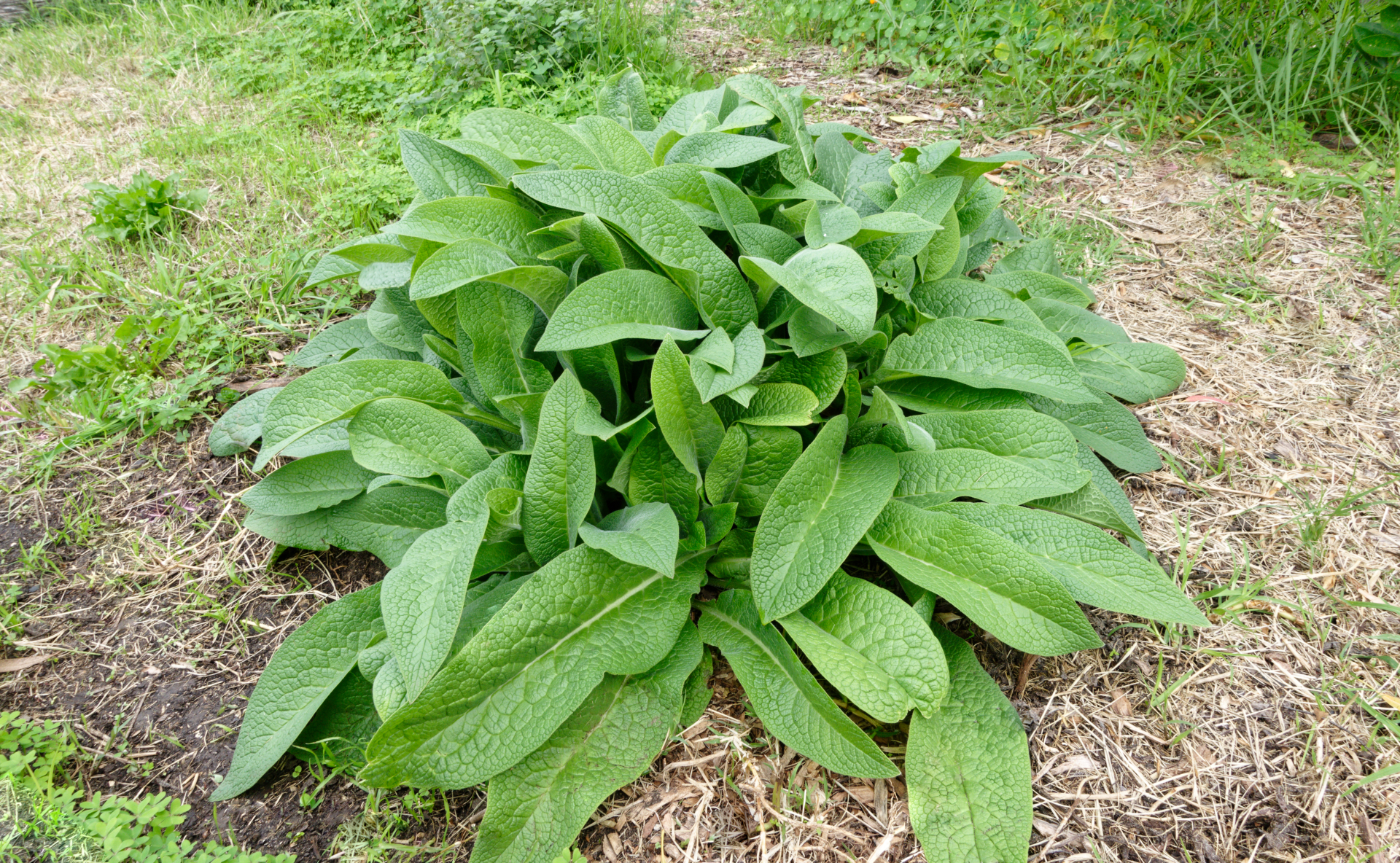
Comfrey, also pictured at the top of this article, is a perennial herb from the Boraginaceae (borage) family, and is known for its deep, extensive root system that can penetrate and break up compacted clay soils. The roots of comfrey can reach depths of 2-3 meters (6-10 feet), although they typically extend to around 2 meters (6 feet) under normal conditions. This extensive root system helps bring nutrients from deep within the soil to the surface, making them available to shallow-rooted plants nearby—a process known as nutrient mining. The deep roots of comfrey significantly improve soil structure and aeration, making the plant drought-resistant and valuable for soil health improvement.
The root system of comfrey is characterized by a thick, fleshy taproot that grows vertically into the soil. This taproot branches out into numerous lateral roots, which further enhance the plant’s ability to access water and nutrients from deeper soil layers. One unique feature of comfrey is its ability to regrow readily from root pieces. If the root system is disturbed or broken, even small pieces of root can regenerate into new plants. This vigorous regrowth ability makes comfrey an excellent choice for soil stabilization and long-term soil health improvement.
Other Uses: Comfrey has numerous uses beyond soil improvement. It is highly valued in permaculture and organic gardening for its role as a dynamic accumulator, which is a plant capable of accumulating particular nutrients at higher concentrations than in the surrounding soil.
The leaves of comfrey are rich in nutrients such as nitrogen, potassium, and phosphorus, making them an excellent green manure. When used as mulch or compost, comfrey leaves decompose quickly, adding these nutrients back into the soil and promoting healthy plant growth.
Medicinally, comfrey has been used for centuries to treat wounds, sprains, and inflammation. Its leaves and roots contain allantoin, a compound that promotes cell regeneration and accelerates healing. Comfrey can be used to make poultices, ointments, and infusions that aid in the treatment of bruises, burns, and joint pain. However, due to potential liver toxicity, it is recommended for external use only and should be used with caution.
Comfrey is also beneficial for composting. Its high nutrient content speeds up the decomposition process, making it an excellent natural compost starter or compost activator. The plant’s leaves can be added to compost piles to enhance microbial activity and improve the overall quality of the compost.
5. Dandelion (Taraxacum officinale)

Dandelion is a well-known perennial herb from the Asteraceae (daisy) family, characterized by its deep taproot, which can penetrate compacted clay soils, typically reaching depths of 15-45 cm (6-18 inches), though it can extend deeper under optimal conditions. This taproot is thick and fleshy, growing vertically into the soil and giving rise to numerous lateral roots that spread out horizontally. These lateral roots enhance the plant’s ability to absorb water and nutrients, contributing to its resilience and vigorous growth.
The deep rooting system of dandelions is highly effective at breaking up hard soil layers, thereby enhancing soil aeration and improving water infiltration. This ability to access deeper soil layers allows dandelion roots to bring nutrients, such as calcium, from the subsoil to the surface. These nutrients then become available to surrounding plants, benefiting the overall soil fertility and plant health in the vicinity.
Dandelions’ deep roots also help stabilize the soil and prevent erosion. Moreover, the plant’s extensive root system makes it drought-resistant and capable of thriving in various soil conditions. When the dandelion decomposes, it adds organic matter to the soil, further improving soil structure and nutrient content.
Other Uses: In addition to its soil-improving properties, dandelion has a wide range of culinary and medicinal uses. The leaves, flowers, and roots of dandelion are all edible and nutritious. The young leaves can be added to salads for a slightly bitter, tangy flavor and are rich in vitamins A, C, and K, as well as minerals like iron and calcium. The flowers can be used to make dandelion wine or added to salads, while the roots can be dried and used as a caffeine-free coffee substitute, known for its rich, earthy flavor and liver-detoxifying properties. For more detailed information about how to use dandelion as an edible plant, see the article – Are Dandelion Flowers, Seeds, Roots And Leaves Edible?
Medicinally, dandelion has been used for centuries as a natural herbal remedy. The leaves act as a diuretic, helping to cleanse the kidneys and reduce water retention. The roots are traditionally used to support liver function and improve digestion. Dandelion tea, made from the leaves or roots, is believed to have anti-inflammatory and antioxidant properties, supporting overall health and wellness.
In the garden, dandelion contributes to soil health not only by breaking up compacted soil but also by attracting beneficial insects with its bright yellow flowers. These insects, such as bees and butterflies, play a crucial role in pollination, enhancing biodiversity in the garden ecosystem. Dandelions also help prevent soil erosion with their extensive root systems.
6. Yarrow (Achillea millefolium)
Yarrow is a hardy perennial herb from the Asteraceae (daisy) family, with feathery leaves and clusters of small, white or colored flowers. It has a moderately deep and intricate root system that typically reaches depths of 20-60cm (8-24 inches). The root structure of yarrow is primarily fibrous, with numerous thin, branching roots spreading out horizontally and vertically through the soil. This extensive network of roots helps the plant anchor firmly and efficiently absorb water and nutrients from a larger soil volume compared to plants with less developed root systems.
The fibrous roots of yarrow are adept at penetrating compacted soils, which improves soil structure by creating channels that enhance aeration and water infiltration. These roots also help to break up hard soil layers, making yarrow particularly effective in rehabilitating poor or compacted soils. The plant’s ability to tolerate and thrive in a variety of soil types, including clay and sandy soils, is largely due to this versatile root system.
Other Uses: Yarrow has a wide range of uses beyond soil improvement. It is commonly used in herbal medicine due to its anti-inflammatory, antiseptic, and astringent properties. Historically, yarrow has been used to treat wounds and stop bleeding, which is reflected in its botanical name, Achillea, after the Greek hero Achilles. The plant is also used to make herbal teas that are used to aid digestion, reduce fever, and alleviate colds and flu symptoms. The flowers and leaves can be dried and used in various herbal preparations, such as poultices and infusions.
In addition to its medicinal properties, yarrow is valuable in gardens for attracting a wide range of beneficial insects, including pollinators such as bees and butterflies. The plant’s small, shallow, nectar-rich flowers are particularly effective at drawing in beneficial insects such as ladybirds (ladybugs), lacewings, hoverflies, and parasitic wasps. These insects are natural predators of garden pests and play a crucial role in pest control. The shallow structure of yarrow flowers is ideal for these beneficial insects, which have short mouthparts and cannot access nectar from deeper flowers. By providing a readily accessible food source, yarrow helps sustain these beneficial insect populations, enhancing biodiversity and contributing to a healthier garden ecosystem.
Yarrow can also be used in composting, it’s an excellent natural compost starter or compost activator, where its nutrient-rich foliage helps to speed up the decomposition process and improve the quality of compost.
7. Mustard (Brassica spp.)
Mustard plants, belonging to the the Brassicaceae (mustard and cabbage) family, are recognized for their robust taproot systems. Typically, the taproots of mustard plants extend to depths of 30-90 cm (1-3 feet), depending on soil conditions and specific mustard varieties. This deep rooting ability allows mustard to effectively break up compacted soils, improving aeration and water infiltration. The extensive root system also aids in nutrient cycling by bringing essential nutrients from deeper soil layers to the surface, thus enhancing soil fertility for subsequent crops.
Other Uses: Mustard plants have a wide range of uses beyond soil improvement. In culinary applications, mustard seeds are widely used as a spice and to produce mustard condiments. Mustard greens, which are the leaves of the plant, can be consumed raw in salads or cooked like spinach. These greens are highly nutritious, providing significant amounts of vitamins A, C, and K, as well as minerals such as calcium and potassium.
Medicinally, mustard has been utilized in traditional practices for its anti-inflammatory and detoxifying properties. Ground mustard seeds are often used in mustard plasters to relieve chest congestion and muscle pain. Both the seeds and the greens are also known for their digestive benefits.
In agriculture, mustard is frequently used as a cover crop due to its ability to suppress weeds and reduce soil-borne pests through a process called biofumigation. The breakdown of chemical compounds known as glucosinolates in mustard plants releases substances that help control nematodes and other pests in the soil. To carry out biofumigation, mustard plants are grown and then incorporated (dug) into the soil before they fully mature, typically at the flowering stage. This incorporation can be done through mowing and tilling the plants into the soil, where the decomposing plant material releases bioactive compounds that act as natural fumigants. This cover cropping technique also adds organic matter to the soil, thereby improving its structure and fertility
Ecologically, mustard flowers attract beneficial insects, including pollinators such as bees and natural pest predators such as hoverflies and parasitic wasps. These beneficial insects play a crucial role in maintaining the ecological balance within garden ecosystems, making mustard a valuable plant for enhancing garden biodiversity.
8. Fenugreek (Trigonella foenum-graecum)
Fenugreek is an annual herb from the Fabaceae (legume) family, known for its beneficial impact on soil health, particularly in breaking up heavy clay soils. The plant features a fibrous root system that can penetrate the soil to depths of about 30-60 cm (12-24 inches). This fibrous rooting ability makes fenugreek effective at loosening compacted soils, thereby improving soil structure, aeration, and water infiltration.
The root system of fenugreek is characterized by a network of fine, fibrous roots that spread out horizontally from the main root axis. These roots help to create channels in the soil, enhancing its porosity and enabling better root penetration for subsequent crops. This structure also facilitates the uptake of water and nutrients from the soil, improving the overall health and productivity of the plant.
Fenugreek is particularly valuable in sustainable agriculture due to its ability to fix atmospheric nitrogen. Through a symbiotic relationship with nitrogen-fixing bacteria called Rhizobia, fenugreek roots form nodules that house these microorganisms and convert atmospheric nitrogen into a usable form for the plant. This process not only benefits the fenugreek plant but also enriches the soil with nitrogen, reducing the need for synthetic fertilizers and enhancing soil fertility.
Other Uses: Fenugreek seeds and leaves are widely used in culinary applications, especially in Indian cuisine. The seeds are often used as a spice, providing a slightly bitter, nutty flavor to dishes. Fenugreek leaves, known as methi, are used fresh or dried in various recipes, adding a unique flavor and nutritional value. Fenugreek is rich in vitamins and minerals, including iron, magnesium, and manganese.
Additionally, fenugreek has a long history of use in traditional medicine. It is known for its potential health benefits, including aiding digestion, reducing inflammation, and regulating blood sugar levels. Fenugreek seeds contain high levels of soluble fiber, which can help manage blood sugar and cholesterol levels. Additionally, fenugreek is used to promote lactation in breastfeeding mothers and is believed to have anti-inflammatory and antioxidant properties.
In conclusion, these incredibly useful plants are not only effective at breaking up compacted soils but also contribute organic matter and improve nutrient availability when their biomass decomposes. By integrating these plants into crop rotations or as cover crops, farmers and gardeners can significantly improve soil health and productivity.



Be the first to reply