


Hardwood cuttings are sections of mature woody stem used to grow new plants. They are taken after the season’s growth has hardened, usually while the plant is dormant in late autumn or winter. This is one of the simplest forms of vegetative propagation because mature dormant stems are tough, easy to handle and contain stored carbohydrates and water that keep the cutting alive while roots begin to form.
Leafless hardwood cuttings from deciduous plants also lose very little water compared with leafy softwood cuttings, so they do not need the constantly humid conditions required by actively growing cuttings. Hardwood cuttings are commonly used to propagate deciduous shrubs, fruiting plants and vines such as figs, grapes, currants, gooseberries, quince, pomegranates, mulberries, willows, poplars, privet, forsythia, honeysuckle and spirea.
The technique is also used for narrow-leaved evergreen plants such as yews, junipers, arborvitae (Thuja) and false cypress (Chamaecyparis). These plants retain foliage on their hardwood cuttings and therefore need somewhat different handling while they root.
Because cuttings are produced by vegetative propagation, the new plant is genetically identical to the parent plant. This is particularly useful when propagating named cultivars, because plants grown from seed may not retain the same characteristics.
Softwood, Semi-Hardwood and Hardwood Cuttings
The terms softwood, semi-hardwood and hardwood describe how mature the stem is when the cutting is taken. Softwood cuttings are taken from young shoots during active growth, when the stems are still soft and flexible and carry actively transpiring leaves. They usually root quickly, but they also lose water quickly, so they need high humidity while roots develop.
Semi-hardwood cuttings are taken later in the growing season, after the stems have partly matured and become firmer. They still carry leaves but are tougher and lose water more slowly than very soft new growth.
Hardwood cuttings are taken after the stem has fully matured and become woody. With deciduous plants, this is normally after the leaves have fallen and the plant has entered dormancy. Narrow-leaved evergreens can also be propagated from mature dormant wood, but their foliage remains attached.
The general principles behind propagating leafy cuttings are covered separately in How to Propagate Plants from Softwood Cuttings.
Plants Commonly Propagated from Hardwood Cuttings
Hardwood cuttings are useful for a wide range of woody plants, not just fruit trees and grapevines. They are commonly used for deciduous trees and shrubs such as willow (Salix), poplar (Populus), plane (Platanus), dogwood (Cornus), black locust (Robinia pseudoacacia), Osage orange (Maclura pomifera) and elderberry (Sambucus).
Ornamental shrubs propagated this way include forsythia (Forsythia), privet (Ligustrum), spirea (Spiraea), hydrangea (Hydrangea), viburnum (Viburnum), deutzia (Deutzia), weigela (Weigela), snowberry (Symphoricarpos), tamarisk (Tamarix), barberry (Berberis), euonymus (Euonymus) and some hibiscus. Woody climbers and vines include grape (Vitis), wisteria (Wisteria), honeysuckle (Lonicera), bittersweet (Celastrus), Boston ivy and Virginia creeper (Parthenocissus), and trumpet vine (Campsis).
Fruit and berry plants propagated from hardwood cuttings include figs (Ficus carica), currants and gooseberries (Ribes), quince (Cydonia oblonga), some plums (Prunus), blueberries (Vaccinium), pomegranates (Punica granatum) and mulberries (Morus). Hardwood cuttings are also used for many roses and some rose rootstocks.
Among narrow-leaved evergreens, yew (Taxus), juniper (Juniperus), arborvitae (Thuja) and false cypress (Chamaecyparis) are important examples. Some pines (Pinus), spruces (Picea) and other woody evergreens can also be propagated from mature stem material, although some are much more difficult to root than others.
The form of cutting used depends on the plant. Straight cuttings are the usual choice for readily rooted deciduous plants such as willow, poplar, forsythia, privet, grape, currants, gooseberries and figs, while heel and mallet cuttings retain older wood at their base and are useful for woody plants that root better when that older tissue remains attached.
When to Take Hardwood Cuttings
Take hardwood cuttings after the season’s growth has matured and the plant has entered dormancy. For deciduous plants, this period begins after leaf fall in autumn and continues through winter until the buds begin active growth in spring.
Late winter is especially convenient because hardwood propagation can be combined with winter pruning. Healthy stems that would otherwise be discarded can be selected and turned into new plants.
Narrow-leaved evergreens used for hardwood propagation are also normally cut during the dormant season, from late autumn through winter. Cuttings can be planted soon after they are taken or stored under refrigeration until planting conditions are suitable.
Selecting Suitable Hardwood Cutting Material
The quality of the stem used for a cutting has a major effect on whether it roots successfully. For ordinary straight hardwood cuttings, select healthy, vigorous stems produced during the previous growing season. These should be fully mature and woody rather than soft and green.
On a dormant deciduous plant, the previous season’s growth is usually smoother and younger-looking than the older branch from which it arose. The change to older wood can often be seen as a difference in bark colour, texture or stem thickness. Pencil-thick stems are suitable for many shrubs, vines and fruiting plants.
Where suitable material is available, the lower part of the previous season’s growth, close to where it joins the older wood, can make particularly useful propagation material. Basal sections of woody shoots can root more readily than younger growth farther towards the tip, and some plants also root better when a small amount of older wood is retained. Basal material also provides substantial woody tissue containing stored carbohydrate reserves that help support the cutting before roots become established. After a cutting is taken, auxin produced in the shoot is transported towards and accumulates at the lower end, where it helps trigger the formation of adventitious roots.
Avoid soft, immature shoot tips, weak or excessively thin growth, diseased or damaged stems, badly shrivelled wood, insect-damaged stems and short fruiting spurs where stronger vegetative growth is available. Healthy buds are important because these will produce the new shoots, so where possible choose vigorous vegetative growth rather than weak shoots dominated by flower buds. A new cutting needs to establish roots, stems and leaves before it can support flowers or fruit.
If the parent plant is grafted, take propagation material from above the graft union if the aim is to reproduce the named cultivar. Shoots growing from below the graft union belong to the rootstock, so a cutting taken from one of those shoots will produce another rootstock plant rather than the cultivar above it.
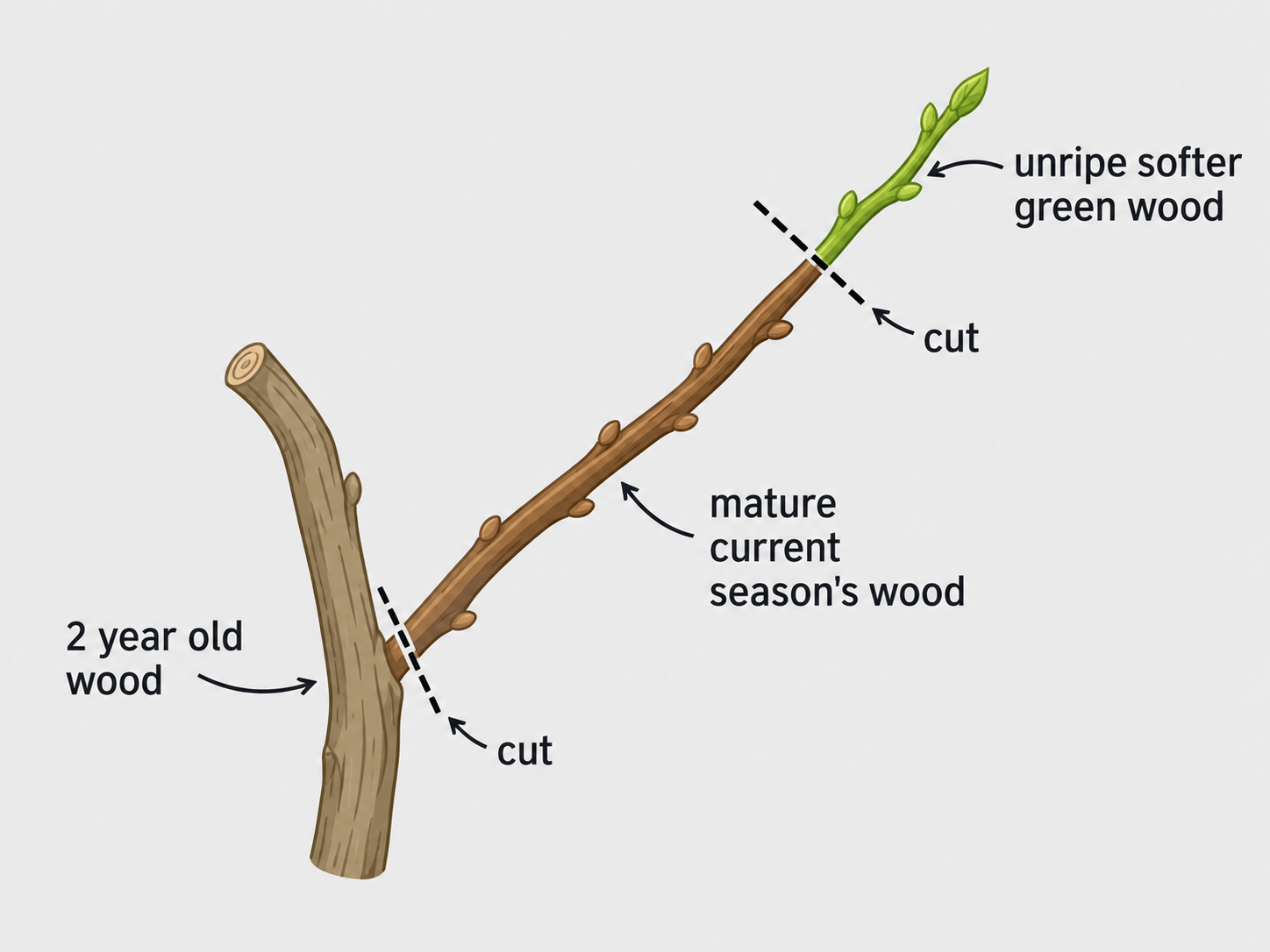
Understanding Buds and Nodes
Before preparing hardwood cuttings, identify the buds and nodes on the stem. A bud contains an undeveloped shoot or flower and is usually visible on dormant wood as a small raised structure on the stem.
The node is the point where a leaf and its associated bud formed during the growing season. After a deciduous leaf falls, its leaf scar remains beside the bud, while the length of stem between two nodes is the internode.
These points matter because new shoots grow from the buds, while new roots often develop from living tissues at or close to nodes and wounded parts of the stem. A useful hardwood cutting therefore contains several healthy nodes and buds rather than simply being a random length of woody stem.
Straight, Heel and Mallet Hardwood Cuttings
Hardwood cuttings are prepared in three main forms: straight cuttings, heel cuttings and mallet cuttings. The difference is not just the shape of the cutting, but whether older wood is retained at the bottom and, if so, how much.
A straight cutting contains only the mature stem being propagated. A heel cutting keeps a small piece of older wood attached to the base, while a mallet cutting retains a complete short section of older stem across the base.
Straight Hardwood Cuttings
A straight cutting is the standard and most widely used type. It consists of a section of mature stem without any of the older branch attached.
This is the normal method for many deciduous shrubs, fruiting plants and vines, including figs, grapes, currants, gooseberries, pomegranates, quince, willows, poplars, privet, forsythia, honeysuckle, spirea and red-twig dogwoods.
Straight cuttings are quick and economical to prepare because one long dormant stem can be divided into several separate cuttings. If a plant roots readily this way, there is no reason to remove older branches simply to make heel or mallet cuttings.
Heel Hardwood Cuttings
A heel cutting retains a small piece of older wood at its bottom end. It is useful for plants that root better when some older stem tissue remains attached, particularly certain narrow-leaved evergreen shrubs and conifers.
To make a heel cutting:
- Select a healthy side shoot growing from an older woody stem.
- Grasp the shoot close to its base and pull it downwards and away from the older branch rather than cutting it off cleanly.
- The shoot should tear away with a small strip of the older branch attached. This piece is the heel.
- Trim away any long, ragged tail of bark or wood, but leave the compact heel attached.
- Remove foliage from the part of the cutting that will be buried.
- Apply rooting hormone where required, then insert the heel and lower part of the cutting into the propagation medium.
The heel provides older wood at the rooting end and creates a relatively large wound, both of which are useful in plants that are slow or difficult to root from an ordinary straight cutting.
Mallet Hardwood Cuttings
A mallet cutting retains more older wood than a heel cutting. Instead of pulling a side shoot away from the parent branch, a short section of the older stem is cut out with the younger shoot still attached to it.
To make a mallet cutting:
- Select a healthy side shoot growing from an older woody stem.
- Cut through the older stem immediately above the point where the younger shoot joins it.
- Make a second cut immediately below the junction.
- Remove the side shoot with the short cross-piece of older stem still attached.
- Trim the older cross-piece to a practical size without removing it.
- Remove foliage from the part that will be buried.
- Apply rooting hormone where required, then bury the complete older cross-piece in the propagation medium.
Viewed from the side, the younger shoot forms the handle and the short piece of older stem forms the head, giving the cutting its mallet-like shape.
Why Use Heel or Mallet Cuttings?
Some woody plants root readily from one-year-old stem growth alone, so straight cuttings are simpler and make better use of the available propagation material. Other woody plants form roots more reliably when part of the older stem remains attached at the base, and heel and mallet cuttings provide this older wood while also creating a larger wounded area where roots can form.
They are particularly useful with narrow-leaved evergreens and conifers such as yews (Taxus), junipers (Juniperus), arborvitae (Thuja), false cypress (Chamaecyparis), crowberry (Empetrum) and twinflower (Linnaea borealis), as well as some other difficult-to-root woody plants.
A heel cutting uses only a small piece of older wood, so it consumes less material from the parent plant. A mallet cutting removes a larger section of the older branch and is used where that larger piece of mature basal wood is useful. The practical rule is to use straight cuttings for plants that root readily from ordinary stem sections, and heel or mallet cuttings where the plant is known to root better with older wood retained at the base.
How to Prepare Straight Hardwood Cuttings
For many deciduous shrubs and fruiting plants, cuttings approximately 15–25 cm (6–10 in) long are a useful size. Some plants use longer cuttings, while live stakes used in revegetation can be much larger.
Hardwood cuttings are generally more substantial than many leafy cuttings because they initially have no functioning root system and must remain alive while new roots develop. During this period they depend heavily on carbohydrates and other reserves already stored in the woody stem. Longer stem sections contain larger carbohydrate reserves, which help keep the cutting alive until roots develop and provide material for the growth of those roots and new shoots.
Each cutting should contain several healthy buds. Use clean, sharp bypass secateurs or a propagation knife so the stem is cut cleanly rather than crushed.
Step 1 – Make the Bottom Cut
Find a healthy bud or node near the bottom of the section being used and make the bottom cut on an angle just below it. This is the end that will be inserted into the propagation medium, and the angled cut increases the exposed surface at the rooting end while also making the bottom of the cutting immediately recognisable.
Step 2 – Make the Top Cut
Move up the stem until the cutting contains several healthy buds and has reached the required length, then make the top cut straight across just above a bud. Using different cuts at each end makes the orientation obvious: straight at the top, angled at the bottom. This is useful when preparing or storing large numbers of dormant cuttings because bare stem sections can otherwise be surprisingly easy to plant upside down.
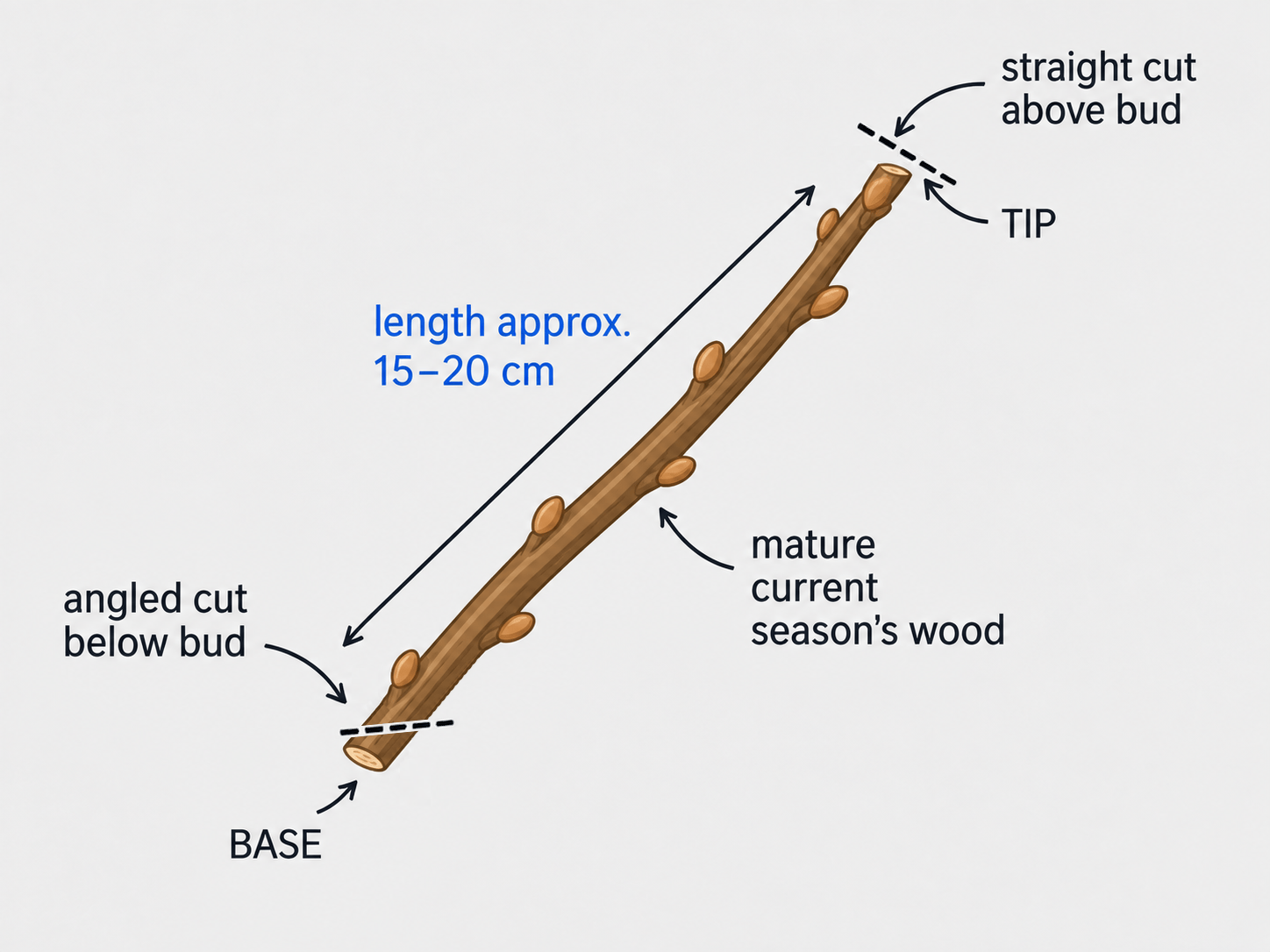
Keep Hardwood Cuttings from Drying Out
Dormant hardwood cuttings lose water much more slowly than leafy softwood cuttings, but they can still dry out. Once a stem has been removed from the parent plant, its root system can no longer replace the water lost from its tissues.
Do not leave freshly collected cuttings lying exposed to sun or drying wind while the planting area is prepared. If they are being planted immediately, keep them bundled together and covered with damp material, place them in a plastic bag, or wrap them in damp newspaper. Label each species and cultivar as soon as the cuttings are prepared because bare dormant stems from different plants can be very difficult to identify once they have been mixed together.
Storing Dormant Hardwood Cuttings
Hardwood cuttings collected in autumn or early winter can be stored until they are ready to be planted. The aim is to keep them cold enough to remain dormant while preventing them from drying out.
Store dormant hardwood cuttings in a refrigerator at 1–4°C (34–40°F). This keeps the buds dormant without exposing the stems to freezing conditions, so do not allow the cuttings to freeze or store them somewhere warm enough for the buds to begin growing.
For a household refrigerator, wrap the cuttings loosely in slightly damp paper towel and place them inside a sealed food-grade plastic bag. The paper should feel damp but should not drip or release water when squeezed. The damp paper maintains humidity around the stems while the bag prevents the dry circulating air inside the refrigerator from dehydrating them. Paper towel is particularly convenient in a refrigerator used for food because it is clean, disposable and does not introduce loose materials such as peat, coir, sphagnum moss, sand or wood shavings into the appliance; slightly damp newspaper can be used for larger bundles in the same way.
Bundle each species or cultivar separately, keep the tops facing the same direction, and label each bundle with the plant or cultivar name and the date collected. Check stored cuttings periodically: the stems should remain firm and dormant, and the paper towel should be replaced if it becomes excessively wet, dirty or mouldy. Remove any cutting showing obvious decay.
Do not store hardwood cuttings beside apples, pears or other ripening fruit, because ripening fruit releases ethylene gas that can damage dormant buds. Once planting conditions are suitable, remove the cuttings from refrigeration and plant them before the buds begin active growth.
Wounding Hardwood Cuttings
Some woody plants root more readily if the lower end of the cutting is lightly wounded before planting. To wound a cutting, use a sharp knife to remove a narrow strip of bark from one side of the bottom 2–3 cm (3/4–1 1/4 in) of the stem.
Make the cut shallow, removing the bark and exposing the living tissue immediately beneath it without carving deeply into the wood. This exposes the cambium and adjacent living vascular tissues at the end where roots need to develop. Cells in these tissues can respond to wounding by dividing and forming the primordia from which adventitious roots develop. Wounding also increases the area of living tissue that comes into contact with rooting hormone when hormone is used.
Heel and mallet cuttings already have a substantial wound at their base, although additional light wounding is sometimes used with difficult-to-root material. Plants that root readily without wounding do not need this extra step.
Using Rooting Hormone on Hardwood Cuttings
Commercial rooting hormones contain auxins that stimulate the formation of adventitious roots. The most commonly used active ingredient is indole-3-butyric acid (IBA).
Rooting hormone is useful for plants that are slow or difficult to root because it can increase the number of roots produced and improve the proportion of cuttings that establish successfully. Products are sold in different strengths, so use one intended for woody or hardwood cuttings and follow the manufacturer’s directions.
When using powdered rooting hormone:
- Pour a small quantity into a separate clean container.
- Dip the bottom of the cutting into the powder.
- Coat the freshly cut or wounded area.
- Tap the cutting gently to remove excess powder.
- Discard any powder left in the temporary container.
Do not repeatedly dip cuttings into the original container because moisture and pieces of plant tissue can contaminate the remaining product. Applying more rooting hormone does not produce more roots, and excessive auxin can suppress root formation instead of improving it. Plants such as grapes, willows, privet and many other easy-rooting deciduous shrubs normally root without hormone, while rooting hormone becomes more useful with plants that are slower to root, particularly many woody evergreen cuttings.
Willow water is a traditional rooting treatment made from young, actively growing willow stems. Willow tissues are natural sources of auxins and contain other biologically active compounds that can influence rooting. Unlike a commercial rooting hormone, however, a homemade willow extract has no standardised concentration, so its composition and strength vary with the willow material and the way it is prepared. It is therefore best regarded as a traditional biological rooting aid rather than as the equivalent of a commercial IBA product of known concentration.
For a home-made plant propagation preparation made from willow stems, see How to Make Home Made Plant Rooting Hormone – Willow Water.
Choosing a Propagation Medium
A hardwood cutting needs both water and oxygen while roots are forming. If the medium becomes too dry, the cutting can dehydrate before it establishes roots; if the medium stays saturated, there is too little air around the buried stem and new roots, increasing the risk of rot.
A good propagation medium therefore needs to retain moisture while still draining freely and maintaining plenty of air-filled pore space. It also needs enough structure to hold the cutting upright and should contain little or no fertiliser because the cutting cannot make effective use of fertiliser until roots have formed.
A commercial propagation mix works well. Suitable media can also include a good-quality potting mix for easy-rooting plants, coarse sand, coconut coir, a 1:1 mixture of peat and coarse perlite, or a 1:1 mixture of peat and coarse sand. Peat or coconut coir mixed with coarse perlite is particularly useful because the peat or coir holds moisture while the perlite maintains air spaces around the stem and developing roots.
Coarse sand is also used in hardwood propagation, particularly for narrow-leaved evergreen cuttings and nursery propagation beds. It provides physical support and can form a porous rooting medium when the particle size is appropriate, although it is considerably heavier than perlite-based mixes. Whatever medium is used, it must retain sufficient moisture without remaining waterlogged.
Propagating Hardwood Cuttings in Pots
Pots are useful when only a small number of cuttings are being propagated, when the garden soil drains poorly, or when the cuttings need to be kept in a protected position.
Use containers with unrestricted drainage holes and enough depth to hold approximately two-thirds of each cutting below the surface, leaving the upper three buds visible. Fill the containers with moist propagation medium.
If rooting hormone has been applied, make a planting hole with a dibber, pencil or narrow stick before inserting the cutting so the medium does not scrape the hormone from the base of the stem.
Insert the cutting with the angled bottom end pointing downwards and space multiple cuttings approximately 5 cm (2 in) apart in a larger propagation container. Firm the propagation medium gently around the cuttings and water thoroughly so it settles against the buried stems.
Where to Keep Potted Hardwood Cuttings
Place containers in a sheltered position with good light and protect them from drying winds, excessive heat, prolonged waterlogging and severe frost. Once tender new leaves begin expanding, also protect them from strong direct afternoon sun until the developing root system can supply enough water to support the foliage.
A cold frame or greenhouse provides a protected environment and can promote earlier root development by keeping the rooting zone warmer than cuttings left exposed to colder outdoor conditions. Adventitious-root initiation and development are strongly affected by root-zone temperature. Keeping the rooting medium moderately warm while the air remains cooler encourages root formation without promoting excessive early shoot growth. Bottom heat can be used where still faster or more reliable rooting is required.
Leafless hardwood cuttings do not normally need to be sealed inside plastic bags or kept under continuous mist in the way that leafy softwood cuttings do.
Cuttings that root successfully in containers over winter may be ready to separate and transplant in spring. Check that they have developed enough roots to withstand handling before separating them. Because container-grown roots can be moved with their rooting medium, they normally suffer less root disturbance than rooted cuttings that have to be dug from an outdoor nursery bed.
Propagating Deciduous Hardwood Cuttings in the Ground
Many leafless deciduous hardwood cuttings can be rooted directly in a nursery bed. Choose fertile, workable soil that drains well because the cuttings may remain there through an entire growing season while their roots and shoots develop.
Avoid sites where the soil remains saturated through winter. The soil needs to hold enough moisture to prevent the cutting drying out while still allowing oxygen to reach the buried stem and new roots.
The Slit-Trench Method
A slit trench provides a quick way to plant a row of dormant hardwood cuttings.
- Push a spade vertically into the soil and rock the handle backwards and forwards slightly to open a narrow slit. In heavy clay soil, place a layer of coarse sand or grit in the base of the trench around the rooting zone.
- Insert each cutting with its angled bottom end pointing downwards, with approximately two-thirds of its length below the soil and the upper three buds visible.
- Space the cuttings approximately 5 cm (2 in) apart along the trench. If planting several parallel trenches, leave approximately 30 cm (12 in) between rows.
- Press the soil firmly around the stems so there are no large air spaces around the buried sections.
- Water thoroughly to settle the soil around the cuttings. Because the cuttings are dormant and leafless, they lose little water during winter, while cool conditions and winter rainfall normally keep the soil damp for long periods. Check the bed during unusually dry weather and water if the soil begins to dry.
- Label each species and cultivar immediately.
- Leave the cuttings in the nursery bed through the following growing season. By the next autumn, successful cuttings should have developed a substantial root system and can be lifted after they become dormant again. Waiting until dormancy reduces water stress when the young plants are dug up and avoids disturbing their developing root systems during active shoot growth.
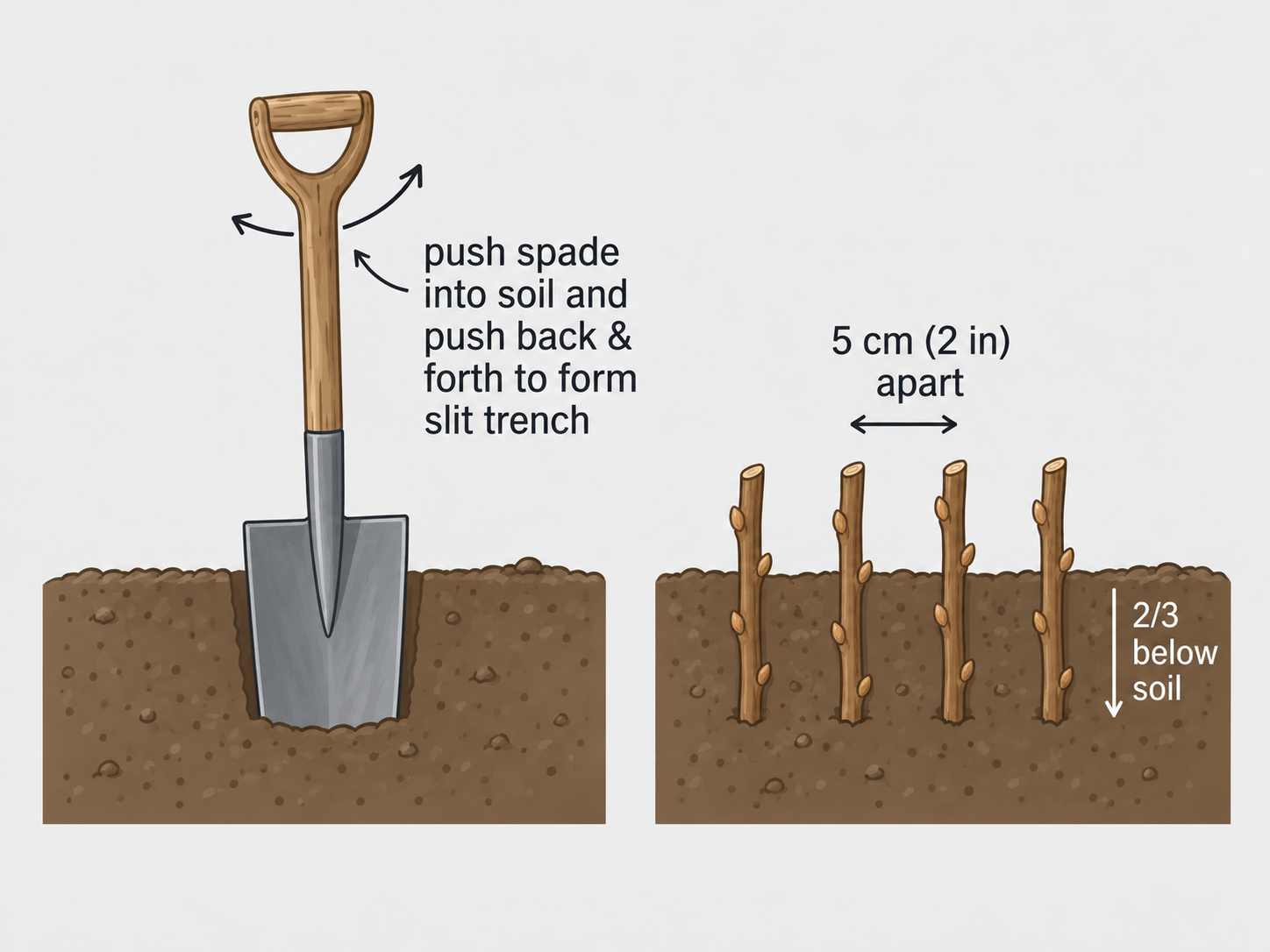
Keep the nursery bed free of weeds and water during dry weather.
How Deep Should Hardwood Cuttings Be Planted?
Dormant deciduous hardwood cuttings are normally planted quite deeply, with most of the stem below the surface and only the upper buds exposed. This keeps most of the cutting in a cool, moist environment, reduces drying, helps hold the stem firmly in place and puts several nodes into the rooting zone.
A useful working depth for the method described here is approximately two-thirds of the cutting below the surface, leaving the upper buds exposed.
Some plants are planted even more deeply. Fig cuttings can be buried with only the top bud exposed, while pomegranate hardwood cuttings are often planted with only 5–8 cm (2–3 in) above the surface and at least three nodes below ground.
The important point is to keep most of the dormant stem in the moist rooting zone while leaving viable buds above the surface to produce new shoots.
Watering Hardwood Cuttings
During winter, dormant leafless cuttings use very little water, so there is no reason to keep adding water when the soil or propagation medium is already moist. Potted cuttings need closer attention because the smaller volume of growing medium can dry more quickly than garden soil.
As temperatures rise and the buds begin growing in spring, water demand increases because the cutting may now have expanding leaves but only a small developing root system. Check the rooting medium regularly and water before it dries completely, but do not keep it permanently saturated or leave pots standing in water because roots need oxygen as well as moisture, and waterlogged media increase the risk of the base of the cutting rotting.
Propagating Narrow-Leaved Evergreens from Hardwood Cuttings
Hardwood propagation is not limited to leafless deciduous plants. Narrow-leaved evergreens such as yews (Taxus), junipers (Juniperus), arborvitae (Thuja) and false cypress (Chamaecyparis) are also propagated from mature dormant wood.
These cuttings retain foliage, so they continue losing water while roots are developing. Take mature dormant shoots from late autumn through winter. Straight cuttings are used for many species, while heel and mallet cuttings are useful where retaining older wood at the base improves rooting.
Remove needles or scale foliage from the lower portion of the cutting so no foliage is buried in the propagation medium. Wound the bottom of difficult-to-root cuttings where appropriate and apply a suitable rooting hormone before inserting them into a porous, well-drained rooting medium.
Coarse sand, perlite-based mixtures and other highly aerated media are useful because they hold the cuttings firmly without keeping the base waterlogged. Evergreen hardwood cuttings need more protection from drying than leafless deciduous cuttings because their foliage continues to lose water, so keep them protected from strong sun, dry air and wind while roots are forming.
Bottom heat can improve rooting in many evergreen hardwood cuttings. Warming the rooting medium encourages root activity while cooler air above the propagation bench helps prevent excessive shoot growth.
Choosing Straight, Heel or Mallet Cuttings for Evergreens
Many low-growing junipers, arborvitae, false cypress and yews can be propagated from mature straight cuttings, while some junipers and other difficult-to-root evergreens respond better when older wood is retained at the base.
Heel cuttings provide a small piece of this older wood, while mallet cuttings retain a larger cross-section. Yews are commonly propagated using heel or mallet cuttings, and similar methods are used for other woody evergreens such as crowberry and twinflower. These forms are used because the plant roots better from that kind of basal material, not because they are simply alternative shapes of cutting.
What Happens After a Hardwood Cutting Is Planted?
A hardwood cutting has no roots when it is first planted, but its stem tissues are still alive. The stem contains stored water, carbohydrates and other reserves accumulated before dormancy.
After planting, living cells around the wounded base, the nodes and the vascular tissues become active. New adventitious roots form inside the stem and eventually emerge through the outer tissues.
A pale or swollen mass of wound tissue called callus may also form around the bottom cut. Callus is part of the wound-healing response, but it is not a root system, so a cutting can produce callus before any roots appear. Roots may emerge through or beside this callused tissue, around nodes, or from other living tissues near the wounded bottom of the stem.
New Shoots Do Not Prove That Roots Have Formed
One of the easiest mistakes to make with hardwood cuttings is assuming they have rooted as soon as the buds begin growing. A dormant stem already contains stored water and carbohydrates, and these reserves can support bud break and several centimetres of new shoot growth before a useful root system exists.
A cutting can therefore produce healthy-looking leaves while still having very few roots or none at all. If the new shoot uses the stored water in the stem faster than the developing roots can replace it, the leaves can suddenly wilt.
Do not pull newly sprouted cuttings out of the propagation medium to check them because the first new roots are fine and brittle and can easily be torn off.
How Long Do Hardwood Cuttings Take to Root?
Rooting speed depends on the plant, the condition of the cutting, temperature and the rooting environment. Easy-rooting plants under favourable conditions can begin forming roots within several weeks, while outdoor cuttings taken during winter may remain apparently inactive until temperatures rise in spring.
There is usually no reason to disturb cuttings in a nursery bed as soon as the first roots appear. Allowing them to remain in place through the growing season gives them time to develop a much stronger root system before transplanting, while difficult-to-root evergreen hardwood cuttings can take considerably longer than easy-rooting deciduous plants.
How to Check Whether Hardwood Cuttings Have Rooted
Once a cutting has had enough time to begin rooting, hold the stem gently near its base and apply a very light upward pull. A rooted cutting will resist movement because the new roots are anchoring it into the surrounding medium, but do not repeatedly tug at cuttings because newly formed roots are easily damaged.
With potted cuttings, roots may eventually become visible through the drainage holes, and a well-rooted cutting will also begin to hold the propagation medium together when it is carefully removed from the pot. The cutting is ready to move when it has developed enough roots to support its new shoot and survive handling, not simply when the first root appears.
Potting Up Rooted Hardwood Cuttings
Water the propagation container before removing rooted cuttings because moist growing medium separates more easily and is less likely to tear fine new roots. If several cuttings are growing together, loosen the medium around the roots instead of pulling the stems apart.
Transfer each rooted cutting into its own pot filled with good-quality potting mix. Spread the roots naturally through the new container rather than forcing them into a small hole, then fill around them with potting mix and firm it gently.
Water thoroughly after potting and keep newly potted plants protected from severe heat, direct afternoon sun and drying winds until their roots begin growing into the new mix. Once active growth resumes, gradually move them into the normal light conditions required by that species.
Hardening Rooted Evergreen Cuttings
Evergreen hardwood cuttings that have been rooted under protected conditions need to be acclimatised before being exposed to normal outdoor conditions. Increase ventilation gradually and reduce protection from humidity over time rather than moving freshly rooted plants directly from a protected propagation area into hot sun or strong dry winds.
Once the plants have developed active roots and new shoot growth, pot them individually and gradually move them into their normal outdoor growing conditions.
Growing Hardwood Cuttings Through Their First Season
The purpose of the first growing season is to build a strong root system and vigorous young plant. Keep newly rooted plants adequately watered, especially during warm or dry weather, because their root systems are still much smaller than those of established plants.
Keep nursery rows free of weeds so the young plants do not have to compete for water and nutrients, and move container-grown plants into larger pots when their roots fill the original container.
If a newly propagated fruiting plant produces flowers or young fruit, remove them during the establishment period because the young plant is better off putting its limited resources into roots, stems and leaves rather than trying to carry a crop. Hardwood cuttings established in a nursery row are normally left there through their first growing season.
When to Transplant Hardwood Cuttings
Ground-grown deciduous hardwood cuttings are best moved after they have completed their first growing season and become dormant again. Dig around the plant widely enough to retain as much of the root system as possible, lift it carefully and replant it promptly so the roots do not dry out.
Container-grown plants can be transplanted once they have developed a strong root system that holds the potting medium together and supports the growing shoot. Cuttings rooted successfully under protected conditions over winter may reach this stage by spring because they can develop roots earlier than cuttings left in a cold outdoor nursery bed.
Allowing ground-grown plants to establish for a full season before moving them generally produces a stronger plant with a much larger root system and reduces the amount of active growth present when the roots are disturbed.
Examples of Plants Propagated from Straight Hardwood Cuttings
The same general straight-cutting method can be used for many plants, but the cutting length, planting depth and number of buds differ between species.
Figs
Take dormant fig cuttings from healthy one-year-old wood during winter and prepare pieces approximately 20–25 cm (8–10 in) long. Discard weak, soft or poorly matured shoot tips and plant the cuttings deeply in a nursery row or deep container so that only the upper bud remains above the soil or propagation medium.
Keep the rooting zone moist as growth begins. Figs root readily from hardwood cuttings and can develop into strong young plants during their first growing season.
Pomegranates
Take approximately 25 cm (10 in) of healthy one-year-old pomegranate wood in late autumn or winter, using stems around 6–13 mm (1/4–1/2 in) thick.
Plant the cutting deeply so that only approximately 5–8 cm (2–3 in) remains above the surface and at least three nodes are below the soil or propagation medium. Pomegranate cuttings can be rooted in containers or directly in a nursery row, and rooting hormone and bottom heat can improve rooting although the plants can also root without them.
Mulberries
Take mulberry hardwood cuttings while the plant is dormant. Select healthy mature stems produced during the previous growing season, remove weak shoot tips and damaged material, and prepare standard straight cuttings containing several healthy buds.
Bury most of each cutting in a nursery bed or propagation container, keep the rooting zone moist as the buds begin growing and allow the young plants to develop a strong root system before transplanting them.
Quince
Take healthy one-year-old quince wood during dormancy and prepare cuttings approximately 20–25 cm (8–10 in) long with several viable buds.
Plant them deeply in a nursery bed or propagation container and keep the rooting zone moist while roots develop. Allow the rooted plants to grow through the following season before transplanting them during dormancy.
Currants
Currants are among the easiest fruiting shrubs to propagate from dormant hardwood cuttings. Take healthy one-year-old stems during late autumn or winter and prepare cuttings at least 20 cm (8 in) long.
Plant most of each cutting below the surface in a nursery bed, leaving one or two healthy buds exposed. Rooting hormone is unnecessary for routine currant propagation, and the nursery bed should be kept moist and weed-free while the plants establish.
Blackcurrants, redcurrants, white currants and golden currants can all be propagated this way.
Gooseberries
Take gooseberry cuttings from healthy one-year-old dormant wood and prepare pieces approximately 15–20 cm (6–8 in) long with several healthy buds.
Plant at least half of the cutting below the surface in a nursery bed or container. Gooseberries establish more slowly than currants, so leave the cuttings undisturbed while a substantial root system develops and grow them through their first season before moving them.
How to Propagate Grapevines from Hardwood Cuttings
Grapevines are particularly well suited to hardwood propagation. Choose healthy one-year-old canes that grew during the previous season and have matured into firm woody stems.
Use well-ripened canes around pencil thickness or greater and avoid thin, weak tips or excessively vigorous sections with very long spaces between buds. Prepare grape cuttings with 3–4 healthy buds, remove tendrils and small lateral shoots, and keep track of the original top and bottom of each section.
Plant the cuttings in a nursery bed or deep container with the lower buds below the surface and two healthy buds remaining above the rooting medium. Firm the soil or propagation medium around the cutting and water thoroughly.
Grapevines root readily from dormant hardwood cuttings and do not require rooting hormone for routine propagation. Several grape cuttings can be rooted together in a larger container. Separate them into individual pots after they have begun producing new leaves in spring and have developed enough roots to withstand handling.
Grow the young vines separately for their first year so they can develop strong root systems. Transplant them to their permanent positions the following spring while they are dormant.
How to Propagate Grapevines Using Vine-Eye Cuttings
Grapevines can also be propagated from very short pieces of mature cane containing a single bud. These are called vine-eye cuttings and are useful when only a small amount of valuable propagation material is available because one cane can be divided into many more individual cuttings.
For the vertical vine-eye method, prepare a section of dormant cane containing one healthy bud by making the upper cut approximately 6 mm (1/4 in) above the bud and leaving approximately 5 cm (2 in) of cane below it. Insert the lower section into the propagation medium so the bud remains at or just above the surface.
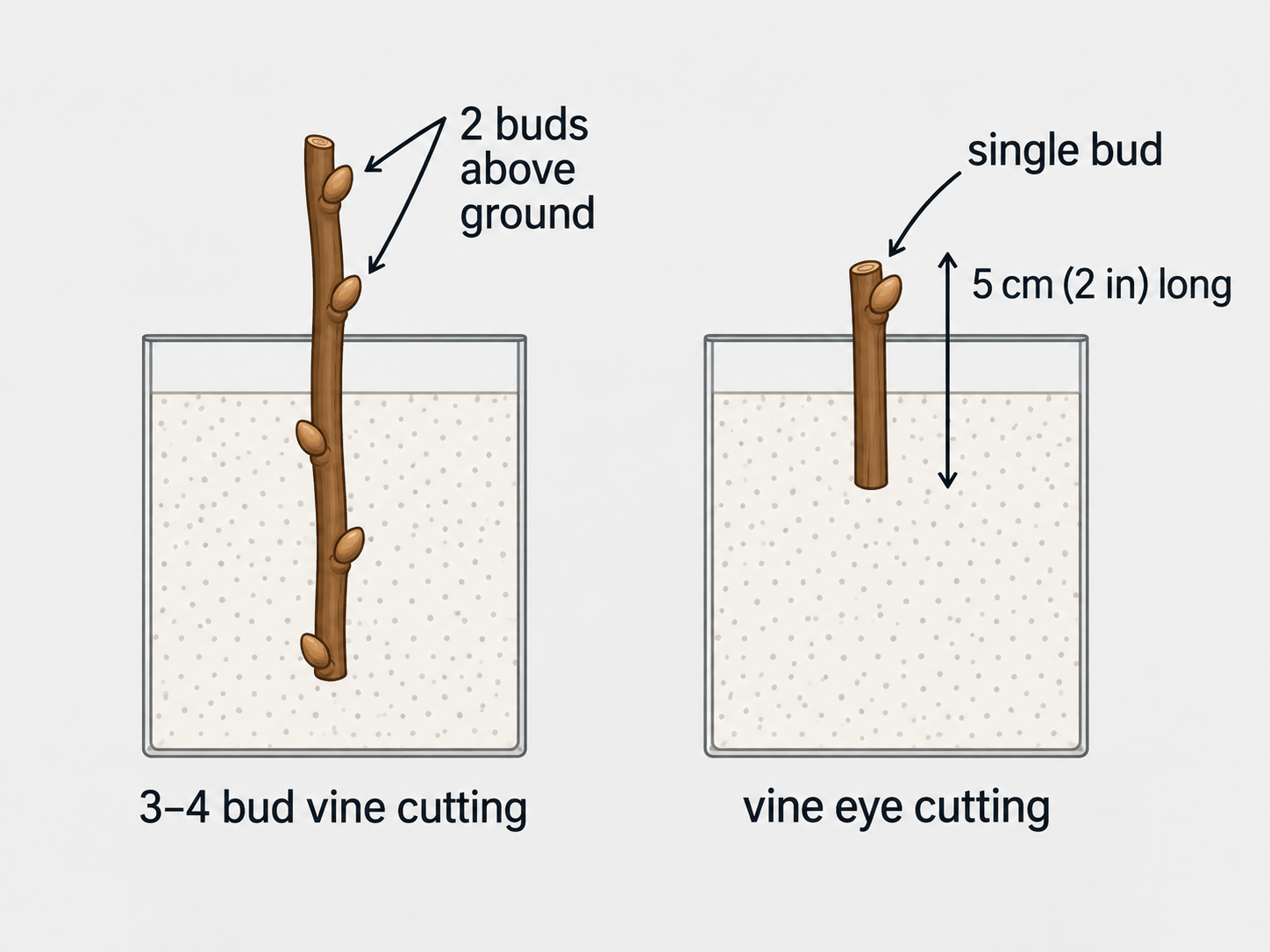
A vine-eye cutting contains much less woody stem than a conventional 3–4-bud cutting and therefore carries fewer stored reserves. It is consequently less robust during establishment and requires more careful control of moisture and propagation conditions.
In a direct 2025 comparison, conventional 4–5-node grape hardwood cuttings produced substantially longer shoots, more leaves, longer roots and almost four times as many roots as single-node cuttings. Overall rooting was also higher in the conventional hardwood cuttings, at 95.6% compared with 83.7% for the single-node cuttings under the conditions tested.
The advantage of vine-eye cuttings is that they make very efficient use of propagation material. Because each cutting uses only one bud, a limited length of valuable cane can be divided into many more individual propagation units than would be possible with conventional multi-bud cuttings.
Single-node grape cuttings can also be rooted horizontally under controlled propagation conditions. In the 2025 study, horizontal single-node cuttings rooted earlier and more effectively than vertically planted single-node cuttings. This is an alternative single-node propagation system and does not replace the vertical vine-eye method described above.
How to Propagate Kiwifruit from Hardwood Cuttings
Kiwifruit can be propagated from dormant canes removed during winter pruning. Take mature canes during winter before sap flow begins and prepare cuttings approximately five to six nodes long.
Keep the original top and bottom clearly identified because dormant kiwifruit cane can be difficult to orient once it has been cut into sections. Insert the lower one or two nodes into a deep container filled with suitable propagation or potting mix, and lightly wound and treat the lower portion with rooting hormone where required to encourage root formation.
Water thoroughly and allow the cutting to grow through its first season in the container. If both male and female kiwifruit vines are being propagated, label the cuttings as soon as they are collected because once dormant cuttings from different vines have been mixed together, their sex cannot be determined from the bare stems.
Examples of Heel and Mallet Cutting Applications
Heel and mallet cuttings are particularly useful with woody plants that benefit from retaining older wood at the base.
Yews
Yews (Taxus spp.) can be propagated from mature stem cuttings, including heel and mallet cuttings that retain older basal wood. Remove foliage from the part of the cutting that will be buried, treat the base with rooting hormone and insert it into a well-aerated medium such as coarse sand or a peat-perlite mixture, keeping the foliage protected from drying while roots develop.
Junipers
Many junipers can be propagated from hardwood cuttings. Low-growing forms often root readily from straight cuttings, while some other junipers root more successfully from material containing older basal wood.
Heel cuttings provide a simple way to retain this older tissue. Pull a healthy side shoot downward from an older branch so a small heel remains attached, trim the heel neatly, remove foliage from the section that will be buried, apply rooting hormone where required and insert the cutting into a porous propagation medium.
Arborvitae and False Cypress
Arborvitae (Thuja) and false cypress (Chamaecyparis) can also be propagated from mature hardwood material. Straight cuttings are commonly used, while heel cuttings can be used where retaining some older wood improves rooting.
Remove foliage from the buried portion, apply rooting hormone where required and use a well-drained propagation medium.
Crowberry and Twinflower
Crowberry and twinflower are further examples of woody plants propagated from one-year-old growth with older basal wood retained. The older wood can be retained as a small heel or as a larger mallet section, depending on the propagation method used for the plant.
Hardwood Cuttings Used as Live Stakes
Hardwood propagation can also be carried out on a much larger scale. Plants that root very readily from dormant stems, particularly willows and poplars, can be propagated from large cuttings planted directly where the new plants are needed. These are known as live stakes.
Live stakes are used for revegetation, streambank stabilisation, erosion control and establishing woody vegetation without first growing plants in nursery containers. A practical live stake may be approximately 45–75 cm (18–30 in) long and 1.3–3.8 cm (1/2–1 1/2 in) thick, although much larger poles are used in restoration work.
Collect the stems while the plant is dormant, remove side branches and keep the original top and bottom clear. Insert a substantial portion of the stake into moist soil while leaving viable buds above ground. If the soil is firm, make a pilot hole with a metal rod first so the bark is not stripped from the cutting as it is inserted.
Firm the soil around the stake so there are no large air pockets. The same process occurring in a small hardwood cutting then takes place on a larger scale: adventitious roots grow from the buried section while shoots emerge from viable buds above the soil.
Common Problems When Propagating Hardwood Cuttings
The Cutting Shrivels and the Bark Becomes Wrinkled
A shrivelled cutting has lost too much water. This can happen because the cutting dried out before planting, because stored cuttings were kept too dry, or because the rooting medium was allowed to dry excessively.
Keep freshly collected material protected from sun and wind, store it under moist conditions and do not allow the rooting zone to dry completely.
The Bottom of the Cutting Turns Brown, Black or Soft
Soft, dark tissue at the bottom of the cutting indicates decay, and the common cause is excessive moisture combined with poor aeration. Use a free-draining propagation medium, keep drainage holes open and do not leave pots standing permanently in water; in the ground, avoid nursery beds that remain waterlogged through winter.
Buds Open but the New Shoots Later Wilt
The buds can begin growing using water and carbohydrates already stored in the stem before a useful root system has formed. If the new leaves begin losing water faster than the developing roots can replace it, the shoots wilt.
Keep the rooting zone moist and protect new growth from hot sun and drying wind while the roots continue developing.
Callus Forms but No Roots Appear
Callus is wound-healing tissue, not a root system. Its presence shows that the stem is alive and responding to the wound, but the cutting still needs to form adventitious roots, so leave it undisturbed while rooting continues.
The Cutting Remains Dormant While Others Begin Growing
Not every cutting begins growing at the same time. A living dormant cutting should remain firm rather than becoming dry, brittle or rotten, and if necessary a tiny area of bark can be lightly scratched to check for green living tissue underneath.
Leave viable cuttings in place even if neighbouring cuttings have already started growing.
The Cutting Pulls Out Easily
The cutting has not yet developed enough roots to anchor itself. If it has been disturbed, carefully put it back into place and leave it alone because repeatedly pulling cuttings out to check them can break the first roots as they form.
Evergreen Cuttings Dry from the Tips
Evergreen hardwood cuttings retain foliage and therefore continue to lose water while roots develop. Protect them from strong sun, low humidity and drying winds, keep the rooting medium moist without saturating it, and maintain sheltered conditions until roots are established.
The Cutting Was Planted Upside Down
Bare dormant stems can be surprisingly difficult to orient after they have been cut into sections and bundled together. Keep the tops aligned while preparing and storing the cuttings, make the top and bottom cuts visibly different, and always plant the original bottom end into the propagation medium.
Turning Winter Prunings into New Plants
Hardwood propagation makes useful planting material from stems that are often already available during winter pruning. The method is straightforward once the correct type of cutting has been chosen: select healthy mature wood at the correct stage of dormancy, decide whether the plant is best propagated from a straight, heel or mallet cutting, and protect the material from drying while it is prepared.
Prepare the cutting with a clearly identifiable top and bottom, wound the base and apply rooting hormone where those treatments improve rooting, then place the cutting into a moist, well-aerated propagation medium and leave it undisturbed while roots develop.
In the pot and slit-trench methods described here, approximately two-thirds of the cutting is buried and the upper three buds remain above the surface. With narrow-leaved evergreens, healthy foliage is retained above the medium while foliage on the buried portion is removed.
For very easy-rooting plants such as willows and poplars, the same principle can be extended from small nursery cuttings to large live stakes planted directly into the ground.
Take more cuttings than the number of plants required because not every cutting will establish. Those that root successfully can be grown through their first season until they have developed strong root systems and are ready to transplant.
Instead of discarding suitable winter pruning material, use it to grow more plants.
Happy propagating!
References
- Arab, A., Alizadeh, M., & Seifi, E. (2025). Enhancing grapevine (Vitis vinifera L.) mass propagation: Single-node cuttings vs. traditional approaches. Journal of Applied Horticulture, 27(2), 254–259. https://doi.org/10.37855/jah.2025.v27i02.47
- Braun, L. C., & Wyse, D. L. (2019). Optimizing IBA concentration and stem and segment size for rooting of hybrid hazelnuts from hardwood stem cuttings. Journal of Environmental Horticulture, 37(1), 1–8. https://experts.umn.edu/en/publications/optimizing-iba-concentration-and-stem-and-segment-size-for-rootin/
- Dumroese, R. K., Luna, T., & Landis, T. D. (Eds.). (2009). Nursery manual for native plants: A guide for tribal nurseries. U.S. Department of Agriculture, Forest Service. https://research.fs.usda.gov/download/treesearch/33057.pdf
- Iowa State University Extension and Outreach. (2024). Propagation of trees, shrubs, and vines from hardwood cuttings. https://yardandgarden.extension.iastate.edu/how-to/propagation-trees-shrubs-and-vines-hardwood-cuttings
- Kansas State University Research and Extension. (2020). Grapes (MF635). https://bookstore.ksre.k-state.edu/download/grapes_MF635
- Kumar, M. G. N. (n.d.). Propagating shrubs, vines, and trees from stem cuttings (PNW152). Washington State University Extension. https://pubs.extension.wsu.edu/product/propagating-deciduous-and-evergreen-shrubs-trees-vines-with-stem-cuttings/
- Montana State University Extension. (2026). Cloning at home. https://www.montana.edu/extension/lila_extn/winter2026/cloningathome.html
- New Mexico State University Cooperative Extension Service. (n.d.). Propagation of grape vine cuttings: A practical guide (Guide H-322). https://pubs.nmsu.edu/_h/H322/
- North Carolina State University Extension. (2021). Extension gardener handbook: 13. Propagation. https://content.ces.ncsu.edu/extension-gardener-handbook/13-propagation
- Oregon State University Extension Service. (n.d.). Growing table grapes. https://extension.oregonstate.edu/catalog/ec-1639-growing-table-grapes
- Oregon State University Extension Service. (2021). Growing kiwifruit in your home garden. https://extension.oregonstate.edu/catalog/em-9322-growing-kiwifruit-your-home-garden
- Pennisi, B. V., Dorn, S., & Sawyer, S. (2023). Starting plants from cuttings for the home gardener (Bulletin 1553). University of Georgia Cooperative Extension. https://extension.uga.edu/publications/detail.html?number=B1553
- University of Alaska Fairbanks Agricultural and Forestry Experiment Station. (n.d.). Propagation of woody plants. https://www.uaf.edu/afes/places/gbg/research/files/pdfs/1985.Holloway.prop_.woody_.plants.pdf
- University of California Agriculture and Natural Resources. (n.d.). Cuttings. https://ucanr.edu/site/uc-marin-master-gardeners/cuttings
- University of Colorado Extension Service. (1938). Plant propagation. https://hermes.cde.state.co.us/islandora/object/co%3A8892/datastream/OBJ/download/Plant_propagation.pdf
- University of Florida Institute of Food and Agricultural Sciences. (n.d.). Cutting types: Hardwood cuttings. https://propg.ifas.ufl.edu/05-cuttings/02-types/02-cuttingtypes-hardwood.html
- University of Florida Institute of Food and Agricultural Sciences. (n.d.). Cutting types: Heel cuttings. https://propg.ifas.ufl.edu/05-cuttings/02-types/03-cuttingtypes-heel.html
- University of Georgia Cooperative Extension. (n.d.). Home garden figs. https://extension.uga.edu/publications/detail.html?number=C945
- University of Georgia Cooperative Extension. (n.d.). Pomegranate production. https://extension.uga.edu/publications/detail.html?number=C997
- University of Minnesota Extension. (n.d.). Planting and transplanting trees and shrubs. https://extension.umn.edu/garden-and-home/yard-and-garden/gardening-in-minnesota/planting-and-transplanting-trees-and-shrubs
- U.S. Department of Agriculture, Forest Service. (n.d.). Balsam poplar. In Silvics of North America. https://research.fs.usda.gov/silvics/balsam-poplar
- U.S. Department of Agriculture, Forest Service. (2025). Tropical nursery manual: A guide to starting and operating a nursery for native and traditional plants. https://www.fs.usda.gov/rm/pubs_series/wo/wo_ah732.pdf
- U.S. Department of Agriculture, Natural Resources Conservation Service. (2019). Propagation of woody plants by dormant hardwood cuttings (Plant Materials Technical Note MT-29, Rev. 1). https://www.nrcs.usda.gov/plantmaterials/mtpmctn13539.pdf
- U.S. Department of Agriculture, Natural Resources Conservation Service. (2007). Hardwood cuttings: Slips, whips, live stakes, poles, and posts. https://www.nrcs.usda.gov/plantmaterials/orpmctn6826.pdf
- University of Wisconsin–Madison Division of Extension. (n.d.). Extending the garden season. https://hort.extension.wisc.edu/articles/extending-garden-season/


i need to know why hard wood cutting is done during dormant seasom and why other types of cutting done in active growing season
Simply because these cuttings, being of different levels of maturity, taken in different of the seasons, have the greatest potential for root development at these times.
So Here is my attempt to explain, hope it helps, with deciduous trees, as the seasons change to colder temp. the sap moving inside the xylem or sap wood, begins to slow down, this process acts as an anti freeze for the plant, when the season begins to warm the sap begins to rise and move through the plant again, awakening it to another season of growth. With many(most) hardwood cuttings, have to go through a process known as callusing. This process sends concentrations of hormones to the callus, those collections of hormones result in the bud meristems ability to differenciate between growing roots or shoots(leaves,branches.) If hardwood cuttings do not callus over before being exposed to consistent moisture, mostly you end up with rotten cuttings. Also using the right medium helps water content in the soil. Herbaceous or green wood cuttings are different, because sugars move freely for the entire season, the plants ability to differenciate hormones to growth meristems is easily obtained, and there is not as much of a need for excess storage of food because there is no dormant period, or in the case of some perennials, they may die back to the ground but they have some sort of enlarged root system like kudzu for example. Thry store just enough food to keep the roots healthy and to shoot up the first groeth when the soil warms. With these perennials i have found it easy to propagate with root cuttings or division. Even in mid summer ive propagated milkweeds and perennial sunflowers from root cuttings, just plant and keep semi moist until you see growth, let the soil dry but not completely before giving it some water, ive found it best to do them in indirect sunlight or even shade when its reallllly hot. In most cases of herbaceous cuttings ive taken them anytime during the growing season, reduce the amount of leaves by 2/3 and keep moist in shady area until you see new growth. Hard wood cuttings are best for deciduous plants or trees because they are in a state of rest, by the time they callus over and form roots, they then can get the energy to produce leaves, and then ultimately grow a larger stronger root system. sometimes ive had hardwood cuttings send out a set of leaves, so they can photosynthesize to grow roots, mostly ive experienced them rooting in, and in warmth they send out leaves and begin growth. I have also done softwood cuttings for deciduous trees and shrubs, that is a very effective way to propagate, however the attention required is more intensive vs hardwood cuttings whoch require a lot less care in most cases. One last thing.. another way o have seen hardwood cuttings done is by air layering or even taking a one gallon plastic pot or 2 liter bottle and cutting a slit, slide it on the branch and fill it with soil, in the spring keep it moist and once rooted in the container cut it from the main plant. Hope that helps!
I want to get roots on Pecan wood. What will you suggest?
You can propagate pecan trees (Carya illinoensis) from cuttings, but they’re propagated using softwood cuttings with leaves in late spring to early summer when the tree is no longer dormant and actively growing. See the article Propagating Softwood Cuttings for step by step instructions on how to do this.
Right on…..
Amazing. Thanks for this explaination.
You’re welcome! 🙂
Very nice instruction. I’ ll be pruning my 2nd year grape vine tomorrow. Will also be propagating a few vines, which i hope does leaf. Thanks for the confidence 🙂 those illustrations are very nice and helpful.
This is very good information, I wish I had found it 2 weeks ago when I tried some ponds seedling plum cuttings in pots.
Looks like I have over much cutting left above the soil – about two thirds. Anyone know if it will be helpful at this stage to cut them down? They were 30cm long to start with. I think I can do this without disturbing the bases of the cuttings.
Also, I have them in an unheated greenhouse but this is unshaded and gets very hot in the sun – would they be better placed in a shadier location under a cold frame or cloche?
You can cut down the cuttings if you want as long as there are a few buds still left above the ground where leaves will emerge. If they are in a greenhouse, the humidity should support the longer cuttings.
Try cutting some down, and leaving others the same length, you’ll see which works better that way.
All greenhouses should be shaded on very hot days otherwise you’ll cook everything inside, drape some shadecloth over the roof and sun facing walls!
A shaded greenhouse is desirable, but failing that you could use a coldframe to speed up the root formation.
Thanks for this. I have cut some down. It might not be to late to try some more following all the advice provided. Unfortunately the greenhouse is to big to shade easily so I will have to be on the ball with the ventilation on sunny days. I might transfer them to a cold frame when the weather warms up.
No worries about the greenhouse getting overheated in the last few weeks! This is to report that all my greenhouse cuttings have come into bud. I put them low down in a shaded area. The ones that I left ‘long’ came into bud earlier than the ones I cut down to just 3 buds showing. I am very concerned about watering. My 50/50 peat/sand mix seemed to remain damp constantly and I understand that the cuttings should not be in a wet medium. I don’t want to over water, but I feel sure that there must be some drying out on the warm days in the greenhouse. With this in mind I give them the occasional dribble of water. I hope I am doing the right thing.
I have mine in pots in my basement. There are grow lights there, but not right above the cuttings. I put stakes in and then wrapped plastic around. I mist the inside of the plastic every few days. Water about 2 to 3 times a week. ALL have put out leaves in the past week.
My question is, do I need to water with soluble fertilizer? We plan to put them out at the earliest, this fall as we are looking to buy a small farm. We may not be in it until next winter (2018) or early spring (2019)
Once cuttings have roots and put on some growth, it’s time to pot them up in a proper potting medium to provide nutrients, and then they’re placed in a protected environment to harden off a little and grow further.
If I start a Yuca hardwood cutting in the greenhouse on March 1 what is the earliest date on which I can transplant?
They’re just like any other plant propagated by hardwood cuttings!
Thank you. They are in pots as we speak. I intend to transplant on May 1 into raised beds. That will give me 2 months in the greenhouse and 6 months in the ground. They require 8 months total to produce the big tubers. I will have stem cuttings for sale…
how would you do a silver maple or a oak tree
Silver maple (Acer saccharinum) can be propagated from softwood cuttings , but
Oak trees cannot and are propagated from seed, plant the acorns!
To do all my Silver Leaf Maple Trees, I did about 40, as I sell them, I merely collected the little helicopters that flew off them and landed on the ground and they grew perfectly. Did not cover just layed them on top of soil and they rooted.
I have a question. if a bud that is below the soil line on a hardwood cutting (buried in the dirt) breaks, will this become a root? thanks. I know that callus is supposed to form in order to get roots, but I have some cuttings that the buds below ground break and they send out a whitish shoot, just wondering if these will become roots?
yes they will become roots you can watch this happen by using plastic bottle on a vine or a small limb after several weeks so can see white hair like roots forming wait several more weeks to cut limb or vine to plant.
Hai,
Based on your experience,can you list down what plants is difficult to propagate?
It’s easier to list the ones that do propagate easier instead! I prefer to do my research first and check whether plants can be propagated, by which methods, and what conditions they require for successful striking. Much easier than spending months waiting or trial and error.
Howdy, Great article. But I have a question can Sugar Maple Trees be propagated by hardwood cuttings? If so what time of year can this be done? Thanks
Sugar maples are not that easy to propagate, they take some effort – here’s an extract from the USDA Forestry Service article on Sugar Maples (http://na.fs.fed.us/pubs/silvics_manual/volume_2/acer/saccharum.htm):
“Cuttings of sugar maple can be rooted but may later fail due to poor overwintering survival. Cuttings can be successfully overwintered by forcing the cutting to break bud and produce a flush of new growth immediately after it roots with the use of gibberellic acid. Rooting response varies greatly between clones-differences range from 0 to 100 percent, and rooting response tends to be consistent from year to year. Timing the collection of cuttings is critical; those taken in mid-June generally give the best results. A rooting medium consisting of a 1 to 1 mixture of perlite and sphagnum moss, with intermittent misting, has worked well with sugar maple cuttings. The reliability of cuttings to propagate trees with figured wood, such as curly grain and bird’s-eye, has not been verified.”
You might not be able to get hold of a misting propagator or gibberellic acid, but if you keep the humidity up around the cuttings, you won’t need a intermittent misting system. The gibberellic acid is used to force the buds to open and put out new leaves, this forces the cuttings to establish early to prevent them dying over the winter. Worth a try to see what happens!
Thanks for the reply. I’ll try it and see what happens next spring/summer. – Ed
I am planning to propagate Barbados cherry and Pomegranates. What is the best time to do it ,since these are evergreens and wont drop their leaves or go dormant?
I want to propagate a 200 year old black gum tree. Are there any special requirements to propagate it from a cutting? Should this also be done in the fall? I’m going to have to shoot the branches out of the tree to propagate because they are too tall to reach.
Please advise me if I could propagate a Melaleuca Paper-Bark tree from a cutting.
I’m informed that Australian trees are very difficult to propagate.
I just love the look of these trees!
Are currants a hardwood? They certain ‘feel’ hard but Im unsure – how would the be propagated?
Yes, that’s what this article is about! You can also root currant cuttings in water too, I’ve done that accidentally by leaving prunings in a bucket with water – see article here http://deepgreenpermaculture.com/diy-instructions/propagating-herbaceous-plants-from-cuttings/
can you use this method on a baobab branch?
Yes Baobab trees can be propagated from cuttings and from seeds.
You can find some excellent information at http://cropsforthefuture.org/publication/Manuals/Baobab%20extension%20manual.pdf
Can a Japanese maple be propagated? Would it be done at the same time as other hardwoods?
Most Japanese maples cannot be propagated from cuttings, and if the cuttings do grow roots, they are usually weak and can fail soon afterwards, which is why the primary method of propagating Japanese maples is by grafting seedling plants with scion wood from a known variety. Japanese maples can be grown from seed but the seedlings won’t necessarily be the same as parent plant because Japanese maples are openly pollinated, which means they’re pollinated by insects, birds or are wind pollinated, which introduces genetic variation in the seedlings.
I have a question about rooting Confederate Roses. When I rooted them in water, they produced nice roots; however, when I potted them up, the roots did not survive. What can I do differently to be able to root them in water?
If you root cuttings in water and then put them into the ground, the sudden change from lots of water to very little causes the failure. Such cuttings need to be potted up into a small pot that has a fairly moist potting medium, and then you can gradually let the cuttings adapt to a mix that is dryer by gradually watering less often. Eventually, they will be able to survive in a pot or in the ground. It’s important to pot up the cuttings and let them develop a nice strong root ball over several months, don’t be in a hurry to plant them out!
Thanks Angelo for your advice. I will try this next Spring and I bet I’ll have better results! – Daisy
Hi, I have had poor success with propagating wine grape cuttings. I took about 300 cuttings off healthy vines in autumn after the leaves had fallen and moistened and wrapped in paper and put in fridge during winter at 1-2 degrees C. I potted these cuttings in individual pots in a good quality potting mix following applying rooting hormone beginning of summer and have only had about 20% success after 2 months. During this 2 months they have been watered and keep out of direct sunlight. I have subsequently planted all cutting in the ground which was well prepared and has drip irrigation. Still poor results. Since I am establishing a small hobby vineyard I need to re plan what I do next. Any hints of what might have gone wrong.
Take cuttings in winter and plant straight into propagating mix in a pot, in a protected space that gets only morning sun, don’t put them in the fridge.
Grapes propagate exceedingly easy, which is why you can strike them from “vine eye” cuttings that have a single bud.
Hello, we’ll be pruning our apple tree this year. It’s a wild apple tree we happen to have on our land and the apples are simply the best apple I’ve ever had and moreover, it seems to resist bugs and larva quite well!
If I understand right, this method works on trees? (I’m sorry, English is not my first language so sometime I need to ask more questions to be sure ahah) For apple trees, am I better using root activating stuff like the Willow Water mentionned in another article?
I want to take cuttings from wisteria I am in central Ontario. I thought if I got the cuttings started early and well established they would have a better chance of making it through the winter. Is it possible to have 10” cuttings start to root when it is -10%C if I bring them into the heat and humidity of a inside green house, I plan on putting them into water until they start to root or should I put them into something else?
I have sea-buckthorn cuttings in a small green house in water they have started putting up leaves but no roots yet, what chance do I have of any of them actually setting root?
Wisteria can be propagated using hardwood cuttings in winter, it is a deciduous vine so it will be dormant in winter anyway, so the winter shouldn’t make a difference – take your cuttings late winter. You can also propagate wisteria by using softwood cuttings anytime from spring through to the middle of summer, but they’ll have leaves at this time so treat them as herbaceous cuttings.
Thanks for this very helpful article. I followed the instructions on some black currant, box elder (AKA Manitoba maple), chokecherry, and red osier dogwood. I took them all when they were dormant here in March and planted them in propagating medium just now. Do you think I will be able to put them in the ground in fall (late September)? If so, do I need to remove the roots from the propagating medium, or can I just place the containers in the soil (containers are the plant-able kind)?
Thanks again!
If the roots are strong enough and they have put on good growth during spring and summer you can plant them in the ground in autumn.
Also, if you’re using plantable pots, just plant straight into the ground, that’s the beauty of using the commercial plantable coconut coir fibre pots or homemade newspaper pots, they minimise root disturbance and break down in the soil.
if cuttings of hot climate (low land) are introduced in cold climate (high land), the time of sprouting increase considerably to the place originate. if you compare the rate of spout, for the species called Osyris lanceolata which prefer low land or hot climate, you find that there is a significance difference on their sprout percentage. so that why during cutting propagation, ecological condition also play the role for the practice to be successful.
Thank you this is very helpful. I will take a few more cuttings just to make sure it is now April 1, should they be kept warm 70/75% or 45/60%. These are cuttings from wisteria and they are dormant.
Question from tjoneal some time ago higher above asked if buried buds become roots besides calluses. I thought one must prepare length of cutting to include for buried bud because its essential ingredient for producing roots. My question would be opposite. Can one make a cutting which only includes above unburied buds, and insert mechanically damaged bud less portion in medium? Does root production come from Phloem callas, buried bud, or both? Even like cut edge of phloem being point of stump shoot production. Most importantly, since cutting produces “Advantageous” roots paralleling trunk overmulched conditions or branch falls in forest taking root. How essential would next step be for healthy survival of very long lived hardwood tree (Like Green & White Ash having 300 & 6OO yr. lifespans) by utilizing root stock 4 grafting cutting instead because it is already producing root phloem type tissue below soil line, compared to above ground grown branch cutting maturing with bark production below ground. I know wet buried in mulch trunk which is above ground portion of stem produces Advantageous Girdling growth then inevitably failing by allowing entry to outside attackers.
And if cuttings root production is advantageous which wander directionless rather than a driving force like normal root ball growth which radially extend outward. Will cuttings roots need selection and redirection by human when transplanted, which will set their roots proper direction for life? Will hormones change tissue growth for surviving below soil conditions? Last, do Epicormic fast grown emergency sucker shoot growth cuttings lose their unwanted traits and revert back to regular branch production characteristics involving apical regulated hormones as well? Should trunk shoot selection grown from dormant bud reawaken for this method be discouraged? One can identify maturing Coppice grown trees also produced as emergency shoots from original organisms surviving root system by unique trunk roles in heightening bark.
I ask because as Chicagoland’s tree historian, I am attempting to preserve precious living examples of old growth legacy native trees, also Jens Jensen, Olmsted, and Frank Lloyd Wright American Ash which is now endangered species because of extinction causing EAB. Many of these owners including Chicago park dist. mistakenly told treatments which did not always work, needed to protect trees for rest of lives, like Elm still does from DED. So as they succumbed to borers, my efforts included collecting trees last surviving branches, and implementing Coppice “Singling” method from remaining stump cut lowest as possible. Rather than rely on stump shoots poor attachment growing off of taller stumps Cambium edge. Is their other downfalls from growing season cuttings whose leaves need constant moisture halting any desiccation? Besides some tree species types which cutting method does not work for, why don’t experts utilize cuttings & coppice Methods off of historic examples lost to storms or still producing live branches to save organism by propagating new tree from? Scottie Ashtree seed…
I apologies for dictated list of detailed questions written like a fourth grader. Forgot can’t post and then edit like normally do. Otherwise would have proof read whole lengthy thing down. Answers for one or two big questions I had above would be plenty. Thanks 4 keeping Blog fresh with answers.
Okay, let’s try again, repost your questions the way you intended to post them and I’ll delete your last two posts and this one! 🙂
Angelo, thanks! That will be great. I will get to rewriting questions ASAP. Scott Carlini
I want to try to propagate an oak tree in my yard. Is there any way to do so now (in April) or must this be done in fall or winter? I live in Ohio, so the weather is still fairly fall-like.
Angelo, on maturing trees produced from rooting hardwood cuttings, how does buttress root development and anchorage compare to regularally grown trees? If cuttings roots are Advantageous, are they more susceptible to girdling host stem instead of growing radially outward? Will stem tissue portion inserted underground for rooting ever change over to producing root tissue and vented bark instead for continued survival? (This might not even be an issue since only small portion of stem remains below soil.) So with observed differences, can a root cutting hope to achieve species same possible lifespan, or prone to unique problems? I have heard grafted examples perform better than root cuttings regarding fruiting trees, and type of species effects individuals success rate also… Is at least one buried bud (And its hormone production) required for root growth, or can a root be individually produced from mechanically damaged portion, like stem cut or sliced open Cambium? (such as “Budless” stump shoot production or limb topping causing water sprouts). Is ancient Air layering process rooting limbs still attached to tree a better option for Hardwood organisms long time survival? I have yet to uncover any past research results on this subject. Your technical answers could assist me in deciding what is better method to utilize when attempting to preserve individual historic trees, which should live out a century or more without becoming a public safety issue. arrivederla….
Wow, lots of questions! I’ll do my best!
> Angelo, on maturing trees produced from rooting hardwood cuttings, how does buttress root development and anchorage compare to regularly grown trees?
Not sure, I’ve never grown extremely large shade trees from cuttings and grown them to maturity.
> If cuttings roots are Advantageous, are they more susceptible to girdling host stem instead of growing radially outward?
I think you mean adventitious roots (ones that form from shoot tissues, rather than from another root). These would grow normally just like any other roots, as many fruit trees are cutting grown, figs, mulberries and pomegranates come to mind, and the former two grow to very large trees.
> Will stem tissue portion inserted underground for rooting ever change over to producing root tissue and vented bark instead for continued survival? (This might not even be an issue since only small portion of stem remains below soil.) So with observed differences, can a root cutting hope to achieve species same possible lifespan, or prone to unique problems?
Trees are capable of regulating themselves relative to their environment. Think about how stem layering works for propagation purposes. The portion of a cutting below the ground should stay that way and be planted at the same level when the cutting forms roots. Grafting gives the benefit of attaching different roots to a plant to enable it to grow in soils where it normally can’t grow, so if you’re planting a tree where it shouldn’t be planted naturally, it will have a shorter life. Grafted trees don’t live as long as seed grown trees, but both have naturally formed roots. Cuttings grown plants typically have a weaker root system than seedlings or grafted trees, but dwarf trees intentionally have weaker varieties of root systems which they’re grafted onto, which is what makes them dwarf trees. If the tree has a deep taproot, this is something that will only be present in a seedling root (and on a grafted rootstock). Tree cuttings don’t develop tap roots, as this is a structure that forms at the seedling stage.
> I have heard grafted examples perform better than root cuttings regarding fruiting trees, and type of species effects individuals success rate also…
See previous comments
> Is at least one buried bud (And its hormone production) required for root growth, or can a root be individually produced from mechanically damaged portion, like stem cut or sliced open Cambium? (such as “Budless” stump shoot production or limb topping causing water sprouts).
The locations near the nodes where buds form are chosen simply because there us more actively growing meristem tissue there which differentiates into various cell types.
> Is ancient Air layering process rooting limbs still attached to tree a better option for Hardwood organisms long time survival? I have yet to uncover any past research results on this subject.
There is no difference between a plant produced by air layering cutting, which is also a cutting technically, and any other cutting grown plant, air layering is often used to root cuttings that are difficult to root by other methods.
> Your technical answers could assist me in deciding what is better method to utilize when attempting to preserve individual historic trees, which should live out a century or more without becoming a public safety issue. arrivederla….
I hope this information proves useful. I would also recommend contacting production nurseries that supply these trees to see what method they use to grow them, you might have to use grafting or even propagation from seed.
Mr. A. Your concisely detailed answers fit like matching puzzle pieces to the set of technical questions I put forth above. Angelo you have made it confidently clear that grafting onto root stock is the most proven way to go, based on traditional & modern methods. I look forward to learning much more through your tree nursery experience recommendation very soon since I just met someone who can get me in up close to facility operations!
One thing already learned is how important orientating replanted tree’s graft union from direct sunlight is because of it’s fragile bark. And just found 2 pkwy examples damaged in this manor. Regarding early taproot development, I recall how Oaks and even most trees need this stage to produce outbound lateral roots with.
So root stock method is like mating a bulletproof Ford rear axle with Chevy power plant, ha…Wow, Dwarf tree’s regulated stem growth thru limiting root stock types utilized, Cool!
Ironically today most trees sold are all grafted clones, which makes people think that bulbous point is true “Root flare”. Then dangerously bury the real one below soil and mulch. I Have witnessed both pictured and up close Individuals of healthy safe and long lived grafted 2 stock examples. Some well known maturing century old oddities produce exaggerated differences between their trunk circumference, along with clash of bark textures. Thanks for taking time to be thorough here and throughout your blog, passionately educating horticulturists across the world. Enjoy!
What is the best way to graft a lemon graft onto a grapefruit tree
You would use a bud graft, also known as a shield graft or T-graft.
Hi Angelo do u think it’s too late to graft the lemon onto the grapefruit now for we have done it just a couple of weeks ago and also have tried on a mandarin as well please reply to me thanks we live in melb do u know if it will work fora lime tree graft as well and I’m looking for some one who reads his and can help me with a lime tree graft if in melb metro area
Hi Maria, early spring is the right time to bud graft a citrus.
A bud graft is also known as a T-graft or shield graft, you don’t need much material as you only need a single bud, you aren’t grafting a whole piece of scion wood.
I want to get a cutting to graft a limb of a grapefruit into a. Lime tree but I need a cutting of a kafir lime tree if any one who reads this can help me to get a lime cutting I live in glenroy melb Vic. Australia please notify me if anyone can help met
Hi Angelo, can I cut and propagate clematis, put them in soil and sand and keep them on my back patio covered with plastic for winter till spring?
Does a longer cutting with a big part of stem burried under the ground produce a better root system than a shorter cutting?
No, not really, it depends on the plant. Very few plants will grow from long cuttings, and the problem with long cuttings is that it’s harder to keep them covered to maintain humidity, and they’ll have a lot more leaves, which may appear before the roots, drying the cutting out more easily.
thank you for this information! i am hoping to use this method to make a transplant from which i want to grow a bonsai. only problem is i need to start off with a small cutting and pot. if i have 3-4 inches of the cutting under the soil, this would require too large a pot for a bonsai. once it roots, can we then cut off some of the top of the cutting? any other advice for how to use this method to create a bonsai version of my plant? thanks!
I’ve grown bonsai for many years before I had to give it up due to lack of time!
– Propagate your cuttings so you have a plant to begin with.
– Grow and train your plant in a BIG pot for as long as it takes to get the shape you want – this is a PRE-BONSAI and your plant can spend a few years in this form.
– When your plant is ready to pot up into a bonsai pot, prune roots and top as per standard seasonal bonsai maintenance regime.
It makes no difference whether you’re propagating a tree to grow as a shade tree to sit under, or as a tiny bonsai, it all starts off the same way!
I also want to try and grow a cutting to Bonsai. Can a large 2-3″ thick cutting be rooted? And should I cut back to focus energy in making roots grow or should I not cut back the limbs until an extensive root system is established. Also it will be a crepe myrtle I am experimenting with. Thanks in advance.
Can a large 2-3? thick cutting be rooted? If it’s a willow tree. Some trees can most can’t.
No shortcuts to bonsai, it takes time to grow a thick trunk and branching structure, otherwise every bonsai enthusiast will be creating ‘instant bonsai’!
When you do a vine eye cutting, do you rough up what is under the soil and would you use rooting hormones? Thanks
Hi Tom, no you don’t need to scar the bark of the grape vine cuttings below the soil or use rooting hormone, grapes take quite easily, but you can if you like!
On average, how long should it take before you start seeing roots? I have the planted cuttings on my cellar. The temperature is around 60 degrees
Hi Tom, that is a “how long is a piece of string” question – there are far too many variables here, depend on the plant species, the time of year, your climate, the location where you have your cuttings, the humidity levels in the air, the temperature of the propagating medium, whether you use rooting hormone or bottom heat… Basically, they’re ready to grow roots when Nature decides they are, it can be anything from a few week to months.
Hi Angelo
You are really helpful for many people. So I have my question as well.
Hardwood leeafless cuttings around 10cms long, wooding and rooting hormone. I plant them in peat plugs in a container under which there is a heating pad at 24C. Do I need to keep them under a chamber to keep high humidity? Does UV light help? How can I control fungus?
Thank you alot. Greetings from France.
George
Correction > Hardwood leafless citrus cuttings around 10cms long, wouding and deeping in gel rooting hormone.
Thank you Angelo
Propagate citrus by using air layering, citrus will not root from cuttings.
Hardwood cuttings are for deciduous plants and trees (these lose their leaves in winter), citrus is an evergreen tree.
The air layering will work but be sure that the citrus can cope with the soil types in your area, otherwise grow a seedling from seed of a type of citrus that grows well where you are and bud-graft the seedling with your preferred citrus type in early spring using a T-graft or shield graft.
Thank you Angelo!
This is very useful. I will abandon the cuttings rooting for citrus and try seeds.
You saved me alot of time.
I appreciate this
George
Thank you for your concise and easily understandable instructions. Can trees like apple, pear and asain pear be propagated this way? I know they are often propagated by grafting onto rootstock. Will fruit trees grow through propagation of hardwood cuttings? What are the advantages of using this method?
Many fruit trees such as apples, pears and Asian pears can be propagated from cuttings, but as mentioned in a previous comment “…grafted trees don’t live as long as seed grown trees, but both have naturally formed roots. Cuttings grown plants typically have a weaker root system than seedlings or grafted trees…”
The other issue is that any variety of fruit tree, wherever it is in the world, let’s take a Granny Smith apple for example, originally came from a single tree in one part of the world, in this case it was from a seedling that came up by chance from a pile of discarded crab apples in Australia in 1868 and was discovered by Maria Ann Smith, who propagated the cultivar. In each part of the world where a Granny Smith apple is grown, it will be grafted onto a different rootstock to cope with the different soil types and soil conditions, root diseases and numerous other factors.
Also by using different rootstock to graft onto, you can decide how big the tree will grow, from dwarf to full-size and everything in-between.
So, in conclusion, it’s always better to graft apples and pears!
Thank you for sharing your insights with me regarding growing apples and pears from cuttings.
I am wondering if you would be kind enough to tell me if it is advisable to graft a desirable grape variety onto wild grapevines? If so, what method and timing is most advantageous?
Can matured laurel (bay leaf plant) plants be propagated by cuttings? If possible, what could be the best method? What is the usual method for propagating this plant?
Hello, Can I Take hardwood cuttings in mid summer and store them in a fridge up until the next spring, to be planted. Will they still be able to potentially strike?
No, because hardwood cuttings are dormant in winter, which is when you would cut and store them.
Since they are actively growing in summer and still have leaves, they would not want to go dormant, you would be messing up their natural cycle.
The chances of keeping them in the fridge for part of summer, all of autumn and all of winter, which is over half a year, and keeping them alive is unlikely, they are living and need to draw their energy from somewhere to stay alive that long!
Thanks
I was playing around with some grape vine cuttings and planted them probably a month and a half ago.I put some on a greenhouse a neighbor has and some in my basement on a garden heat pad set at 80. Of the ones in the greenhouse probably 30 of the 50 I planted the buds have swollen and some have actually started leafing out. I won’t be able to plant them her until at least the middle of May. Should I put them in a cooler place to slow them down or just keep letting them grow?
I am really eager to try make some cuttings of Teak, Tectona Grandis, and have lots of parent trees to work with. Are there any tricks that I should be aware of with this species or can I follow the steps?
Tectona Grandis propagation? Goodness, talk about a specialized topic! 🙂
Here’s the answer from a published paper on the topic – Vegetative Propagation of Mature Teak Trees (Tectona grandis L.)
By K. PALANISAMY and K. SUBRAMANIAN, Institute of Forest Genetics and Tree Breeding, R.S. Puram, Coimbatore – 641 002, India
Silvae Genetica 50(5/6): 188-191 (2001)
“Summary
Clonal propagation technology for mature teak trees (63 year-old) has been achieved for the first time. Indole butyric acid (IBA) was found to be the most effective auxin tested. Cuttings from coppice shoots of mature trees rooted between 74% to 91% with a 2000 ppm IBA treatment, while the cuttings from 1 to 2 year-old root-stocks (stumps) rooted between 79% to 100% with 1000ppm IBA applied at different times of the year. Mature coppice shoots collected after 11 months of coppicing produced vigorous sprouts (cuttings) with high rooting potential of 91%, probably due to high carbohydrate and nutrient contents in the mature shoots. Adventitious root formation and root system of cuttings collected from planted coppice shoots of 63 year-old mature trees were similar to those of one year-old root-stocks, suggesting the juvenility of coppice shoots regarding rooting. In teak, rooting depends upon the physiological status of the cutting, and season is no longer a major barrier in rhizogenesis.”
That should definitely give you some sound guidelines for propagating teak trees.
i have a heated bench setup in one of my tunnels and i have planted raspberries and blackberries for propagation, i am interested in taking hardwood cuttings now, i know it is late but it will buy me a year, the buds have not burst yet, i was hoping to do 2 bud cuttings and i will be doing 1000 or so, from what i have read they won’t root better than 40%, does that sound about right? next season what is my best option for propagating a large number of plants from each mother plant? if a raspberry plant had crown gall would it be safe to take cuttings from it?
thanks.
Hi Stephen, you mention “I am interested in taking hardwood cuttings now” – I need more information, your ‘now’ in one part of the world may be the opposite season of someone else’s ‘now’ on the other side of the planet! What season are you in specifically?
I am also interested in hardwood cuttings. I try to grow them for bonsai purposes. I’m researching methods of building a cheap homemade heating pad. Would you happen to have any experience or advice as to how I should go about doing this. I though of LED rope lights or an electric blanket; what other ideas do you have?.Thanks.
Hi Joe, proper horticultural propagation heating pads and strips are not that expensive unless you buy the fancy temperature regulated varieties which will hold the cutting medium at an exact temperature, but they are worth the money.
As a person with qualifications in electronics as well (yeah, I’ve done a lot of things in my life!) I would strongly advise against the two suggestions you make for cheap heaters as LEDs are low current devices that are designed to emit lots of light but very little heat, and electric blankets are not designed to be anywhere near damp or moist areas and present a serious electrocution hazard!
In the seed raising article (http://deepgreenpermaculture.com/diy-instructions/starting-annual-vegetable-seedlings-indoors/) I suggest placing the seed trays on top of the refrigerator in late winter to raise warm season seedlings early, an indoor hot water unit will work too, to provide warmth. That would be a cheaper and safer option.
Hi, will first year hardwood cuttings propagate if cut in the spring (I know winter is preferred) or is it a dead loss?
I doubt, as the leaves would already be out, less energy would be stored in the cuttings, and you will need to maintain humidity levels to keep the cuttings alive and prevent moisture loss through the leaves – otherwise it would be a common technique… Sounds like doing herbaceous cuttings with the wrong cutting materials (see http://deepgreenpermaculture.com/diy-instructions/propagating-herbaceous-plants-from-cuttings/) Some plants grow from cuttings easier than others, you’re always able to try it out and see what happens though.
I haven’t done it yet, was thinking about trying a bunch of different cuttings (Hard, soft and in between) now before any leaves show up and wondering if I’ll have any success. I would trim off any leaf buds to make sure the cuttings don’t spend any energy on leafing.
Can I use this method to take cutting from a Tulip tree? It us now April 19. Is it too late to try for this season? The buds are just starting to become visible. Thank you!
Tulip tree (Liriodendron tulipifera) is usually propagated from seed or by grafting. Propagation using cuttings is said to be difficult, and if you choose to try growing from cuttings, use semi-hardwood cuttings taken in mid-summer to early autumn, use current seasons growth that is starting to become woody at the base. I’ll have to write an article on propagating semi-hardwood cuttings soon!
I always had a problem with fungus and dead stick when I tried to clone tree from cuttings.
You shouldn’t have any problems if you follow these instructions. Sounds like your propagating medium is far too wet.
Dear Angelo, I found out too late that I tried rooting a fig cutting at the wrong end using water culture. Instead of the base, the tip is immersed in water. The 2 nodes have sprouted and the shoots are growing well. No fungal infection 11 days later. What do I do from here? The base which is sticking out of the cup is already exposed to air.
You can recut the base, and insert the cutting the right way up in a suitable propagation medium (not water for figs!), but since the leaves are beginning to open you will need to use some form of plastic cover to hold the humidity in – see my article “Propagating Herbaceous Plants from Cuttings” for a detailed description.
Angelo, I’d like to try and propagate some river birch trees via cuttings, can this be done? Any specifics tricks?
Hi what the best way to propagate flowering plum tree.I try layering but not getting much luck.
Nice presentation of step by step process on stem cuttings. Thank you
HI ANGELO … do you also field horticultural questions? What I would like to know (as our informant at this site appears to be very well informed in such areas) is when planting hardwood / softwood cuttings or the seeds of fruit from fruit trees (apple, any of the citrus, etc), is the resultant fruit true to species, or does it produce an inferior ‘sport’ or ‘a deviation from the true’?
YouTube is full of steps on ‘how to’ with respect to fruit trees, but we only get to see the resultant plant over about 2 years.
Are you able to provide an answer to my above question (PS I know the hard / softwood cuttings of mulberry, figs produce great fruit after even a few of months)
With respect, I thank you
Daz
PPS I love the speed of your responses to the inquiries made by your followers (I’m a new one)
Hi Daz, thanks for your question.
Most fruit trees do not grow true to seed, each seed will produce a tree and fruit that will come out different, that’s how trees ensure genetic variation for maximizing their chances of the survival of the next generation. Now you know why deciduous fruit trees are grafted, only by grafting the scion wood from the original tree can you ensure that you get the same fruit each time – so yes, Granny Smith apples for example, worldwide, have all been propagated from the same single tree, quite amazing when you think about it!
Mediterranean fruit trees such as figs, pomegranates and mulberries and grapes can all be grown from hardwood cuttings and they produce genetic clones, no need for seedling grown trees or grafting.
Citrus is grafted to specific rootstock such as flying dragon to create dwarf citrus trees or trifoliata to grow fill size trees that will be suitavle for specific soils.
Most citrus are true to seed because they are in fact polyembryonic, the seeds contain more than one plant embryo, one only embryo is the product of fertilization and the rest are genetic clones of the parent tree. When these seeds are grown they produce multiple shoots, the fertilised one is usually the weakest and is removed.
The following citrus are monoembryonic and don’t grow true to seed – Clementine Mandarin, Meyer Lemon, Nagami Kumquat, Marumi Kumquat, Pummelo, Temple Tangor, Trifoliate orange (also known as Citrus trifoliata, Poncirus trifoliata, Japanese bitter-orange, or Chinese bitter orange).
What are my scion options for grafting japanase maple bud grafts, or any tree or plant will do? Is Japanese maple easily propagated through cuttings and what about the beautiful australian maple and canadian maples. Thank you.
Hi,Angelo,
Great blog for all horticulture enthusiast . May I know where to get tree cuttings of Pomegranate which is a great cultivar for commercial planting? Does it need to apply for phytosanitary certificate from exporting countries?
Thanks! The pomegranate variety “Wonderful” is a popular variety that is used commercially in the US.
It’s a popular variety, so you shouldn’t need cuttings, you should be able to buy trees in many countries.
Hi Angelo,
Germinate from seed would take 2-3 years to produce fruit. Whereas from cuttings it does produce fruit in the same year. How to identity the seedlings sold by the nursery is propagated
of which can bear fruit within a short period of time.
Yes “Wonderful” is popular variety so far. But from my research done. Tunisia soft seed is getting much popular now. Can you enlighten me the market trend now on Pomegranate?
Thank You
From: wagon teoh (Singapore)
Hi sir, great reading those above comments.^^ Im a student at VSU and I want to propagate a Pterocarpus indicus (narra) which is a native spicies in the Philippines would it be possible to grow by cutting? also sir, can you give me published article about this propagation?
…sorry ’bout my english.. thanks…
Hi Eric,
I’m not familiar with this tropical species as I live in a temperate region, but it sounds easy to propage from cuttings, I found information on propagation of Pterocarpus indicus here – http://www.worldagroforestry.org/treedb2/speciesprofile.php?Spid=1763
“P. indicus may be propagated by seed, which germinate in 8-100 days, but the initial growth of seedlings and saplings is relatively slow.
Propagation by cuttings is preferred, especially for ornamental planting. P. indicus is unique among big timber trees in that the capacity for rooting of stem cuttings is not lost with age. Stem cuttings can be taken from trees of any age and size. Cuttings of diameter 6 cm or larger will root better than cuttings of smaller diameter. Young leaf-bearing stems will not root at all. For roadside planting, the cuttings used are in the form of stakes 15-3 m long and as much as 10 cm diameter. Such stakes produce up to 10 radiating shoots at the top, making a symmetrical crown very quickly, above pedestrian height. Few species can match P. indicus in the ability to produce well-crowned instant trees within one or two years. If large stakes fail to root, it is usually because of water-logging or accidental movement of the stakes during the tender rooting period. These problems can be avoided by rooting the stakes in loamy soil in large well-drained containers, while tied securely to a simple supporting framework. The stakes root in about 3 months and can be reduced to as short as 10 cm length, but such cuttings would take longer to develop into trees.”
Thank You…
Hi Sir,
..would it be very possible to clone deciduous tree species sir and what would will be the best tree specie to propagate? would it be possible to clone mangrove specie sir?
Thanks…
Hi Eric, I explain a lot about what you’re asking, propagating deciduous fruit trees, in my article “The Difference Between Seedling, Grafted and Cutting Grown Fruit Trees“. Apologies, I’m not familiar with mangrove species, the nearest ones are hundreds of kilometres from where I live, so I can’t help there.
Have grape cuttings that I would like to root. Have been advised to use perlite and peat moss. Should I add water to the perlite/peat moss mixture before inserting the grape cuttings? Or water after planting?
The perlite/peat moss mixture will work for grape cuttings, as will straight coconut coir, or just well-draining potting mix.
You can water your propagation mix first, so it’s nice and moist, then put the cuttings in.
Hi Angelo, thanks for sharing your knowledge! Would you mind providing detail on rooting hardy Kiwi vines (Actinide kolomikta). Would the same process be used as outlined for grape vines? I planted some last fall adjust realized some kind of critter stepped on them and snapped off some of the longer growth. Id like to make these into cuttings and root them if possible. Thanks JW
How would I do this with a pine tree?
I had a gooseberry bush in a container. I didn’t realize that the roots had grown through into the ground and I accidently broke it off. I pulled the rest of the roots up. Can I get those roots to grow into new gooseberry plants? It is just the roots, no leaves
There are many plants that can grow from root cuttings, such as comfrey and horseradish, but gooseberries can only be propagated from stem cuttings.
What happens to cutting that was taken from dwarf rootstock, will it becomes a full size tree?
All grafted trees, whether dwarf or full sized, are grafted from cuttings (scion wood) taken from one original tree, and grafted to different rootstocks all around the world. So all Granny Smith apples for example all came from one original tree, and all cuttings taken from all other Granny Smith apple trees are clones of that one original tree! All scion wood on all grafted trees is a genetic clones of one particular variety and is always the same, regardless of what rootstock it’s grafted onto! If you take a cutting from a granny smith grafted onto dwarf rootstock, and graft it onto a full size rootstock, you’ll produce a full size tree. The scion wood on the top has nothing to do genetically with the rootstock.
Thank you so much for sharing your knowledge & experience. Propagating is my new passion, now that my 4 kids have grown, I need something to nurture, especially through the long winter months in Illinois 😉 I’ve made several hardwood cuttings of several different species, mostly trees. I’ve planted them in planting medium in a large fish aquarium.
Here are some of the species:
Shawnee Brave Bald Cypress
Prairie Cascade Willow
Crimson Maple
Norway Maple
Roses
Holly shrubs
Flowering Crab
Forest Pansy Redbud
Tulip Tree
Red Plum (fruit)
pyramidal Junipers
Stovepipe Yews
Some of these will probably be a total fail, but this is my first try.
Do these cutting needs to be in the cold for a certain period of time before they will root or can I just keep them inside? If they need to be cold, how cold and for how long?
Thanks so much!!!
I assume the deciduous tree propagation technique works well on ornamental trees (Acer rubrum & palmatum, Cercis canadensis var., Cornus florida & chinensis, etc..) and on longer whips ? Please advise per your experience….. Additionally, do you have any experience propagating Conifers such as Cedrus & Bald Cypress species from cuttings ? We own and run a medium sized retail nursery in Sacramento, CA area. We specialize in smart useful plants and we grow 80% of what we sell because the grower market services mostly an impulse buy market. We successfully propagate our own shrubs and perennials it 2-2500sqft Smart Greenhouses, but have not been successful at trees and conifers mentioned. Would really appreciate and be grateful for any advise. Your article here is very well done ! It is a great service to others (Professionals & DYI-ers)…Thankyou , Dave Bushnell, Bushnell Gardens Nursery.
Hi Dave, thanks for your comment. I haven’t tried propagating any of these trees, many cultivated ornamental trees are often grafted, though it’s different for every kind of tree. You’ll have to investigate each particular species, case by case, to see which performs best with which specific propagation technique. I believe many conifers are cutting grown though they’re slow to grow.
Sound like you have a wonderful business going there, nice to see a retail nursery that grows their own plants!
Happy propagating in 2018!
Thanks! : )
I’VE don’t quite a few grape cuttings with good success. My question is how long is brush viable for cuttings after it’s been pruned? The weather here has been in the single digests, warming up the next few days but back in the teens this weekend. The vineyard was trimmed about 4 days ago, but I can’t get to the brush for probably a week. Thank you
Hi Tom, when I prune my grape vines, if I intend to use the cuttings I place the bottom end in a bucket with a few centimetres of water so the cut ends do not dry out. How long prunings take to dry out before they can be used for propagation is highly variable and depends on wind, sun, humidity and many other factors. People often forget that cold, dry winter winds can strip moisture from plants quite well in certain climates.
If the grape vine cuttings have been left out for a week, I would select the thickest ones as they would retain the most moisture, and I would cut off the bottom portion as this part would most likely have dried out, then propagate as you normally would a hardwood cutting. Please let us know if it works!
Well, there had been both snow and some rain. Once I mage my cuttings I soak them in water for at least 12 hours before burying them upside down until I’m ready to put them in nursery rows.
Very helpful thank you! I had a question about doing my cuttings indoors during the winter. Is it necessary for them to have a light source? And if so can I use grow lights?
You can’t propagate deciduous hardwood cuttings in winter because they’re dormant, and they have no leaves so there is no need for light. If you’re referring to plants that are evergreens, that don’t lose their leaves, yes, some can be propagated under grow lights, and they do even better when you place a propagating heat mat underneath to warm the soil medium to stimulate root growth.
This article is amazing,THANK YOU for not only citing reliable sources but continuing to do so for YEARS following up on comments! Incredible!
We’ve had some crazy weather here in New England, warm spurts that have encouraged budding and now, back to back blizzards! There’s been a LOT of downed branches, many perfectly healthy bystanders crushed by larger limbs. Can hardwood cuttings be successfully propagated from such casualties, their lives cut short so close to spring? Any suggestions regarding temperatures, choosing and cutting the best candidates (lots to choose from!) or other considerations would be greatly appreciated. Species include sugar maple, lilac, crabapple, mulberry, concord grape, forsythia, Japanese maple, rhodedendron… This list goes on! Particularly interested in the lilac, but I’ve read they are especially difficult to root from cutting?
THANK YOU!
The deciduous trees are worth trying to propagate in winter as they’re dormant, anything evergreens won’t strike unless they’re actively growing, which means warm spring weather.
Lilac (Syringa) can be propagated from softwood cuttings 5cm (2″) long, propagate in late spring, use rooting hormone and bottom heat at 15C (59F). Expected time to produce roots is 6-8 weeks. (Source: Alan Toogood – American Horticultural Society Plant Propagation)
Thanks!
Hi Angelo,
I recenlty had a pagoda dogwood come down due to an ice storm. Wondering if I can propigate cuttings in the spring? If so, any suggestions on how to get the best results. Thanks! This has been a great thread!
Hi Eric, since the tree will be in leaf rather than dormant, you could try propagating semi-hard or green cuttings. See the companion article Propagating Herbaceous Plants from Cuttings on how to do this. Please let us know if it works!
How About Sea Grape? Heard it’s possible, but I’d like to plant a bigger branch like 3 inch diameter and 4 feet tall with 3 or 4 buds.. Also, I think I might get in trouble in that I want to plant it in city property. Long story, but the city cut down some big Oak trees because they wanted to move the garbage bin for a large retailer. There is a large open space the size of foot ball field behind my townhouse and from the second floor I now have a terrible view of garbage now that the trees are missing. I called the city and they said they needed to see if they had available funds in the tree fund… then 2 days later a storm hit and I think at least 25% of trees everywhere were down. Side question, but do wonder what the crime and penalty for planting trees in public property is?? I won’t hire lawyer and just imagine me in front of judge defending my actions.
Even small pieces of small logs can have shoots if planted in a nice potting soil.Make a cross slit in the lower extremity.To prevent the cutting from getting torn completely place a retaining wire at a certain height and you are ready to make two slits dividing the log in 4.You might be lucky to have the cutting bear shoots.Just like surgical operations with humans may have some percentage of success,so why not with plants.Cheerio
Hello,
What happens if you do not cut off the growing tip at the top? Is that necessary?
The soft growing tips wilt and lose a lot of moisture, causing the cutting to dry out.
Asimina triloba (north american pawpaw) is considered impossible, or next to impossible, to propagate by cuttings as it multiplies by seed and clonal suckers. What would you recommend to try on pawpaw cuttings?
Can I propagate Box Elder Sensation from cuttings and if so, how?
Sensation Box Elder (Acer negundo ‘Sensation’) can be propagated from cuttings, take softwood cuttings when it’s actively growing and in leaf during the warm seasons. Use rooting hormone and maintain the humidity around the cuttings as the roots apparently take several months to form! Commercially, the humidity is maintained using a misting propagator, but you can place the cuttings in some form of enclosure and manually mist the cuttings with a spray bottle, but you’d need to do that several times a day, which may not be practical. Once they root, they’re potted up and hardened off gradually they repotted as they grow, and this whole process can take a year or more from the cutting stage to having plants that can be planted in the ground.
Are apples trees able to be propagated this way, or only by grafting onto rootstock? How about plums and Asian Pears? Thanks for your help.
Apple trees need to be grafted onto a suitable rootstock, for a detailed explanation please see my article – The Difference Between Seedling, Grafted and Cutting Grown Fruit Trees
Asian plums and pears are also grafted.
Hii good
So how do I go about rooting pecan trees and walnut trees
By grafting or budding onto a suitable rootstock, they can’t be propagated from cuttings, please see my article – The Difference Between Seedling, Grafted and Cutting Grown Fruit Trees
how hard is it to root pecan and black walnut trees can I do it in the fall or does it have to be in the spring and how about air layering
barwickraymond@yahoo.com
Hi, I like your post really I have read first-time Thanks for sharing keep up the good work.
Thanks you, much appreciated!
Hi Angelo,
I have been following your article to take some hard wood plum cuttings and they were doing really well until yesterday when they started looking shriveled, the leaves that had developed have started to dry and curl and I don’t know what has happened.
Before planting I scraped the bottom inch back to cambium, and I used rooting powder.
The soil is damp but not soggy, I don’t know what’s up. There was a hard frost a couple of nights ago but they are in a green house so they will have got cold, but they didn’t get frosted as far as I can tell.
Any suggestions?
Thank you very much for the article btw – very clear and easy to follow, much appreciated.
Hi Ruth, I’m guessing it’s either a sudden extreme temperature change that shocked them, or a wind sweeping past and stripping away the moisture from the leaves. You would want the greenhouse closed on a frosty night to hold warmth and moisture.
Thank you for being here.
I have a Sweetgum/liquid amber that has just been freed from trees that inhibited its growth on one side.
How can I get it to grow new branches on the bare side of the trunk which gets plenty of sun now?
Thank you in advance!
My granddaughter and I are expeimenting how to grow pecan and hickory trees from cuttings using growth hormones. Please help us understand how to do this. Thank you so much
Pecans are propagated by grafting or budding onto a suitable rootstock, they can’t be propagated from cuttings, please see my article – The Difference Between Seedling, Grafted and Cutting Grown Fruit Trees https://deepgreenpermaculture.com/?s=The+Difference+Between+Seedling%2C+Grafted+and+Cutting+Grown+Fruit+Tree
Hickory trees are normally grown from seed, collect seed in autumn, cold stratify over winter at 10°C (50°F) for 4-5 months, then sow seeds in summer. The seeds should germinate in 8-12 weeks, and the preferred germination temperature is approximately 20-30°C (70-85°F). Plant out seedlings in autumn.
Thank you, it’s helpful for me.
The cuts that I made on the lower part of the cuttings are deep and have reached the white layer of the wood. Are the parts that have been cut and have a little cambium less likely to take root?
When wounding the bottom of the cutting, the intention is to just expose the cambium, to create a point where rooting will begin from.If you accidentally cut deeper into the wood, the edges of the cut where the cambium is exposed may possibly help, at worse it won’t do anything.
Thanks for your help, how can I send you a photo of the cuttings?
Another question;
By what means and method should I cut the skin of the face so that the cambium is not damaged?
You can just scrape the bark off with a knife, or more conveniently, with the edge of the blade of the secateurs that you used cut the cuttings with, to expose the cambium layer.
Hi. Can you say why it’s important to tap off the excess rooting powder please ? I’m thinking of taking a hardwood cutting from the top of a male Sea Berry at the end of this year. Will your method described here work please ? Regards.
The excess rooting hormone powder is shaken off because you don’t need much of it to do the job, and you don’t want to waste it. The amount that sticks to the cut end of the cutting will act more directly.
Sea buckthorn (Hippophae rhamnoides) can be propagated from hardwood and softwood cuttings, which require different procedures, and both involve a rather complicated procedures and specialised equipment to get the cuttings to root. Hardwood cuttings are taken in early spring before budbreak, as winter cuttings don’t grow as well and don’t produce the same quality plants. The procedure is a nightmare and I can’t explain it here! See this free publication for more information – Schroeder, W.R. 2017. Seabuckthorn Propagation. Agriculture and Agri-Food Canada, Indian Head, Saskatchewan, Canada. Catalogue No. A59-45/2017E-PDFISBN 978-0-660-09249-2AAFC No. 12696E. Good luck!
ive taken cuttings from ”suckers ” off a haselnut tree ,they sprouted but have different leaves. how come?
Great article.. Will be taking some fig cuttings and planting them in pots this coming dormant season in Melbourne. Is this better done at leaf fall or just before the buds break? Or somewhere in between? Thank you.
I have an additional question. I recently bought a hardwood cutting from a seller and followed their instructions to a T. I’m just wondering how long it will take before I see new growth on the cutting. I keep peeping down the vine protector thing but haven’t seen any growth. It’s been about a month and I got two other grape vines at the same time that were full plants and those have been growing like crazy. They are all watered the exact same way. Any hints would be helpful. Excited to learn the art of growing grapes. :).
I want to try this. I will let you know if i succeed? thank you for sharing. My species is notoriously difficult to root so i will buy some rooting hormone?
I took a hardwood cutting of a mulberry branch and finally got a tiny leaf to grow. My 1 year old found it and pulled it out of the pot and broke that little leaf. I put it back into the pot with plenty of water as soon as I discovered what had happened (close to an hour afterwards). Is there any hope it will continue to grow?
If there are any other buds on the cutting, they will shoot, and it will grow just fine. The cutting just lost a little bit of its stored energy when it lost its first leaf. Normally, mulberry cuttings produce multiple leaves, so it should be okay!
Thank you so much for posting an awesome article! I really enjoyed it. I actually work at a company that specializes in deciduous cuttings and propagation of trees. The article resonated with me because we are going to try this technique as well, thanks for the inspiration!
What if I have a larger cutting that has a couple of smaller branches on it, will that still survive and take root? Or do I need to remove the extra small branches?
If the cuttings are taken from the tips of branches, they shouldn’t have much branching. You have to cut off the lower two-thirds of branches otherwise you can’t plant the cutting. Small stub branches can be left, but long branches are best pruned off the reduce the load on the root system when the cutting puts out roots, as more branches equals more leaves!
I’m an avid gardener and I really enjoyed your article on propagating plants from hardwood cuttings. I took a hardwood cutting myself this winter to propagate the heather in my backyard. It was actually really easy!
I came across your blog post on propagating plants from hardwood cuttings. I’ve tried it myself and it was very easy!