

This post is part-contributed and may contain affiliate links
Advanced trees versus tubestock for a backyard food forest: where the extra money buys years, and where it buys nothing
By Isaac Olson, Nursery Near Me
The same tree can be bought as a tube for a few dollars or as a 45-litre bag for well over a hundred dollars, and the question every food forest builder eventually asks is which is the better buy. The honest answer from the seller is that it depends entirely on the plant’s role in the design. For some layers, the big plant is money thrown away. For a few, it is the best money you will spend on the whole project.
Here is how the sizes actually behave once they are in the ground, and how to decide.
What You Are Paying For
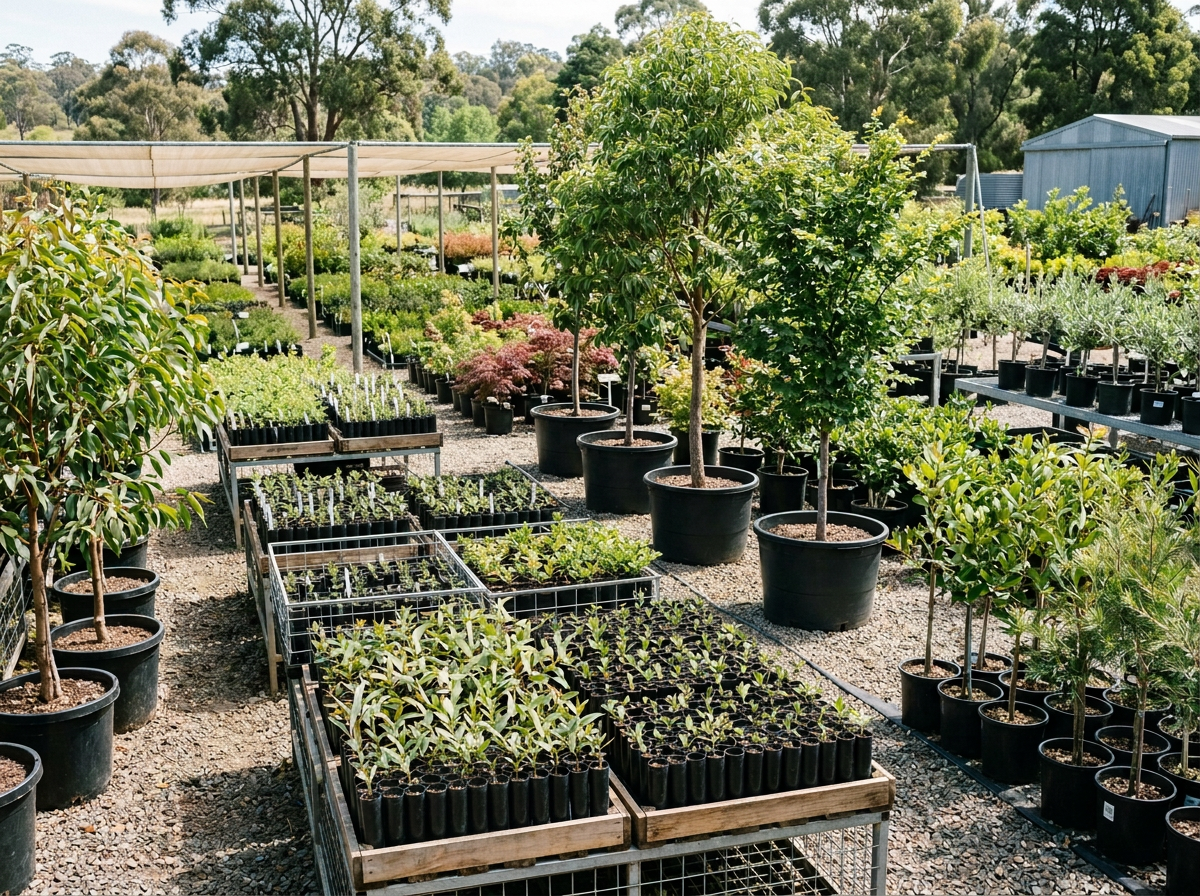
A tube is a seedling or cutting a few months old, with a root system the size of a thumb. A 140- or 200-millimetre pot is about a year from that. A 300-millimetre pot, a 45-litre bag, and anything larger are plants that have spent two, three, or five years in a nursery, being fed, watered, pruned, and potted up. The price reflects the years of labour and space, not just the size of the plant.
What you get for that money is time already spent. What you do not get is a plant that establishes faster. This is the part that surprises people. The bigger the plant, the more of its root system is left behind in the nursery, and the longer it takes to grow enough new roots to support the top it arrived with. A tube can be growing freely in a month. A 45-litre tree can sulk for a full season, and in a dry summer it can go backwards, because a big canopy on a small new root system is exactly the balance a tree does not want. Advanced trees are also the ones most likely to arrive with circling roots and are most in need of staking against wind for the first year.
So the extra money does not buy growth. It buys a head start, and the value of that head start depends on how long the plant would otherwise take to do its job.
Where It Buys Nothing
The understorey and ground layers: Herbs, comfrey, groundcovers, native grasses, lomandras and dianellas, strawberries, and the spreading and clumping plants that fill the floor of a food forest. These grow fast from small stock. They are planted in numbers, and a tube planted in autumn is indistinguishable from a 200-millimetre pot by the following summer. Buying these large is paying for a year the plant would have given you for free.
Fast-growing pioneer and support species: Tagasaste, pigeon pea, the wattles, casuarinas, the nitrogen-fixers, and chop-and-drop plants that a food forest uses to build soil and provide shelter in the early years. These are meant to grow quickly and be cut back hard or removed within a few years. Always use tubes. Some are best grown from seed.
Shrub-layer fruit that grows quickly anyway: Blueberries, currants, brambles, guavas, pepinos, and most of the berry and small-fruit layer. A 140 or 200 millimetre plant is the sweet spot. Larger pots of these exist mostly for people who want fruit this season in a courtyard, not for a food forest planted in numbers.
Anything going into a windy or exposed site: A small plant establishes in the wind. A big plant fights it. On a bare block with no shelter yet, tubestock and small pots will outperform advanced stock within two years, and the money saved buys the windbreak that makes everything else possible.
Where It Buys Years
Canopy trees from small stock are slow to fruit: This is the real case for advanced plants. Macadamia, pecan, carob, mango in the subtropics, and avocado, the large nut and fruit trees that form the top layer, take five to ten years to bear from a tube. A grafted tree in a 300-millimetre pot or a 45-litre bag is typically already three or four years along that road, and it reaches bearing size in the ground years earlier. If the canopy is the point of the design and you would like to eat from it this decade, this is where the money goes.
Grafted citrus and stone fruit in a small garden: A 200-millimetre grafted citrus tree will fruit in its second or third year. A 45-litre one may fruit in the season it goes in. In a food forest with fifty trees, that difference is not worth paying for fifty times over. In a suburban backyard with room for three trees, it often is, because those three trees are the whole harvest.
Structure and shade that the rest of the planting depends on: A food forest is a layered system, and the understorey layers want dappled shade, which does not exist until the canopy is up. One or two advanced trees in the right places give the design its shade and its bones in year one, not year four, and the smaller plants beneath them do better for it. This is the one place where a single expensive tree can raise the performance of a hundred cheap ones.
Screening a neighbour or a road: Not strictly food-forest work, but most backyard designs have a boundary that needs to disappear, or require a windbreak. A privacy screen from tubes takes three years. From 300-millimetre pots, it takes one year. People are usually happy to pay for that extra year.
A Rule of Thumb
Buy small for anything planted in numbers, that grows fast, or that will be cut back. Buy large only for individual trees that are slow to bear, that the rest of the design depends on for shade, or that are doing a job you want done this year rather than in three. In a typical backyard food forest, this means most of the budget goes on many small plants and a small number of large ones, which is the opposite of how most people shop the first time.
Two practical notes to finish. Whatever the size, plant in autumn where the climate allows it, so the roots can establish through winter before the plant faces summer. And when advanced stock arrives, resist the urge to plant it the same day. Give it a few days in the shade, with a deep watering first. Big plants have the most to lose in the first week and the least patience for a rough start.
About the Author
Isaac Olson is a director of Nursery Near Me, an online nursery based in Brisbane that sources from wholesale growers across Australia and delivers to most of the country, from tubestock to advanced trees. Their free plant care guides are at https://nurserynearme.com.au/blogs/blog
Be the first to reply