
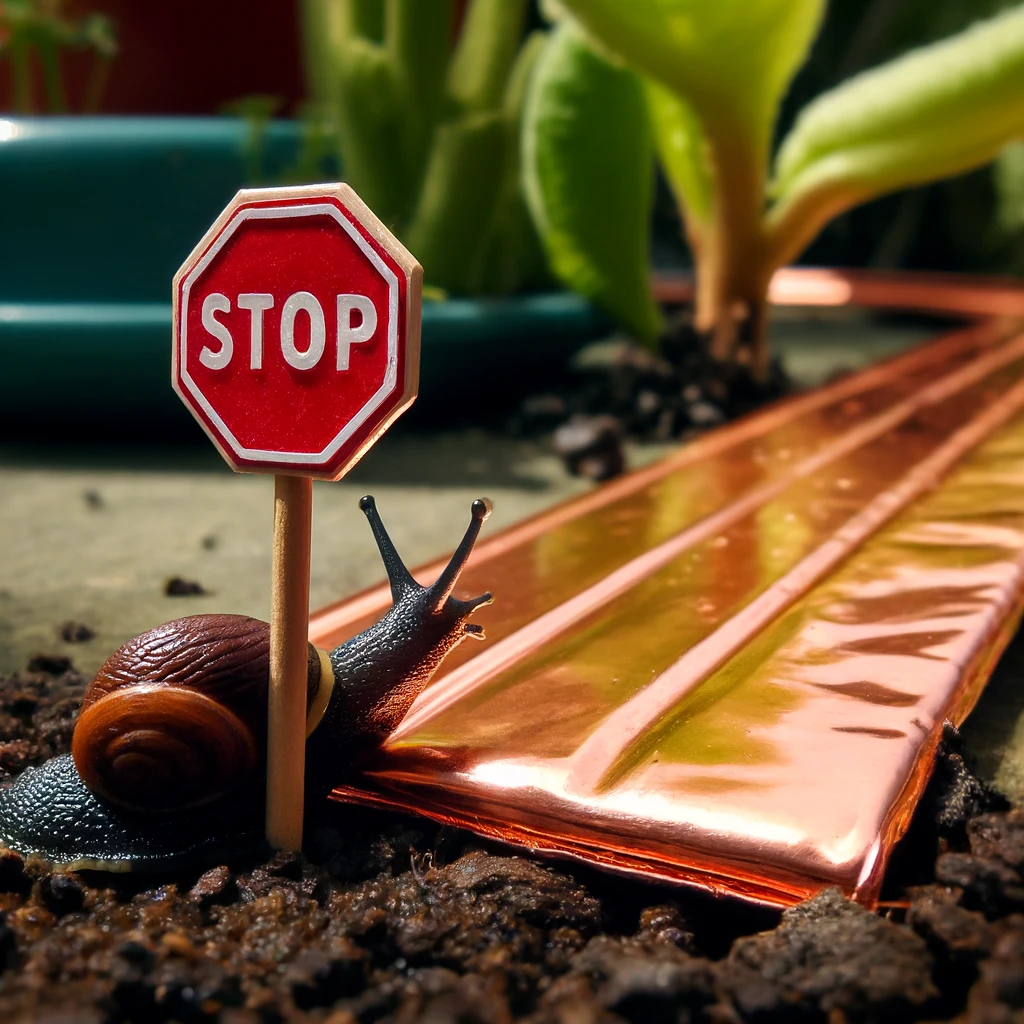

Gardeners and horticulturists have long sought effective, environmentally friendly methods to protect their plants from the voracious appetites of snails and slugs. Among the myriad of options, one solution stands out both for its simplicity and its basis in science: copper strips. But how effective are these metallic barriers? Let’s delve into the science behind copper’s repelling power and address whether it truly provides a line of defense against these garden pests.
The Science of Repulsion
Snails and slugs are repelled by copper strips due to a reaction that occurs when their moist bodies come into contact with the copper. This interaction is believed to induce a mild electrical charge, similar to an electric shock, that deters them.
The mechanism involves the copper reacting with the slime that snails and slugs secrete, which contains ions that can conduct electricity. In chemistry, ions are atoms or molecules that have gained or lost one or more of its valence (outer shell) electrons, giving them a net positive or negative electrical charge. When these ions come into contact with the copper, it creates a difference in voltage across their bodies, leading to what is effectively a tiny electric shock. This uncomfortable sensation discourages them from crossing the copper barrier.
Here’s an action sequence of a slug interacting with a copper strip, which is actually an old copper tree label that was previously tied to a tree.
In the first photo, the slug is heading towards the label at full speed, relatively speaking!

As soon as the slug touches the copper strip, it receives an electric shock, which causes it to retract its eye stalks and turn away.

Immediately the slug changes direction, avoiding contact with the copper strip.

When a copper strip is touched on a moving slug crawling over the edge of a plant pot, it immediately retracts its whole head completely flat into its body.

The exact nature of this reaction is a subject of study and some debate within the scientific community, as it involves complex chemistry and the bioelectrical properties of snails and slugs. However, the consensus is that the repellent effect of copper is effective enough to be used as a barrier method in gardens and agriculture to protect plants from these pests without the need for chemical repellents.
Oxidation: A Potential Weakness?

A common question arises regarding the condition of the copper: What if it’s oxidised? Copper’s effectiveness can indeed be impacted by oxidation, which forms a layer of copper oxide on the surface, potentially reducing its electrical conductivity. However, this doesn’t render the copper entirely ineffective. If the layer of oxidation is not too thick, some electrical conductivity remains, allowing the copper to maintain a degree of its repellent capability.
Once the surface oxidation of the copper progresses to the point where the surface can no longer conduct electricity though, the copper barrier will no longer work as a repellent and these slimy gastropods will simply climb over it.
For gardeners seeking to ensure the highest level of effectiveness, maintaining the copper strips by occasionally cleaning them with a kitchen scourer or steel wool to remove oxidation and restore the shine will enhance their effectiveness as a barrier.
Practical Application and Considerations

When considering incorporating copper strips into garden pest management strategies, a few practical considerations emerge. First, the placement of copper strips is crucial. They should be installed around the perimeter of plant beds or on pots, forming an unbroken barrier that snails and slugs must cross.
In commercial raised garden beds that are elevated on stands, wrapping a copper strip around the legs can serve as a deterrent to snails and slugs, preventing them from accessing the plants within.

Furthermore, the width of the copper strip matters. It should be wide enough to prevent snails and slugs from simply stretching over it without making contact with their entire body, which could negate the electrical effect.
Finally, it’s important to note that while copper strips can significantly reduce the intrusion of snails and slugs, they may not offer a 100% guarantee. Integrated pest management strategies, combining physical barriers like copper with other organic methods, often yield the best results.
For more information on natural and environmentally safe snail and slug control methods, see the following articles:
- How To Eliminate Slugs Naturally With A Coffee Soil Drench
- Garden Pests – How To Control Snails And Slugs Without Toxic Chemicals
In conclusion, copper strips serve as an interesting and very effective method for deterring snails and slugs from invading garden spaces. Their mechanism of repelling pests through the generation of a mild electrical charge offers a unique blend of simplicity and science. However, their effectiveness can be influenced by factors such as oxidation and improper installation. By understanding and addressing these factors, gardeners can better harness the power of copper to protect their treasured gardens from these unwelcome gastropods.



I conducted an experiment last year. I had 20 kale plants in yoghurt containes withthe bottoms removed. I wrapped around the top of 10: 10cm strips of thick new 99.9% pure copper plating. It was a complete barrier and no gaps uderneath. I planeed out the kale in 4 rows, alternating copper barrier, no barrier.
There was no difference in the slug and snail damage sustained. I found slugs happily inside the copper barrier.
After this experiment, I conclude any effect on the mollusc to be too minimal to be of meaningful use in my garden.
Hi Sarah, I’m not sure what went wrong there, if the copper had a clear coating to keep it bright and prevent it tarnishing, that would have stopped it working.
See the other articles I have listed on snail and slug controls also, there are many other ideas for effective barriers, such as using plastic bottles with the bottoms cut off.
I really enjoyed reading your explanation of how copper strips affect snails & slugs, with accompanying action photos! This article is both informative and a fun read. Thank you so much for sharing your gardening knowledge with others.
Thanks, you’re welcome! 🙂
Just keep in mind the strips are limited to the type of surface they stick to.
Good point, which is why you need to get creative sometimes to figure how or where to attach them! 🙂
FYI, the title says snails twice.
Thanks for that, it has now been corrected to “Do Copper Strips Really Work as An Effective Barrier to Snails and Slugs?” 🙂